Showing posts with label Philosophy. Show all posts

Jun 21, 2012

Random reflections on being right.

 
Oh seasons, oh castles,
What soul is without flaws?
      - Arthur Rimbaud

    We all are born into this world with our share of flaws. None of us is flawless. Sometimes it is these flaws in us which make us what we are, teach us the lessons we need to learn and shape our lives for the better. It is not that I claim the flaws and imperfections to be right. But I think they form a necessary part of life's package. As we overcome the flaws, we live our lives. And sometimes that act of overcoming is what turns out to be the most important part of this great drama of life!

    But as individuals, part of the society, we are very much biased towards denying the flaws that characterize us. When a good friend points out a flaw of ours to us, the most common reaction we are conditioned to express is to find ways to defend it. Our mind gets involved in exploiting options and arguments which would put us on the path of being right. But, is being flawless actually being right? Or going a step further, is being right such a huge necessity? 

"There is nothing either good or bad, but thinking makes it so"
 - William Shakespeare (Hamlet)

    What is good and what not? What is right and what not? These are questions not to find answers but to actually find ourselves. An objective answer to these questions has eluded the best of all intellectual minds. The objectivity of right and wrong is battled on the turfs of moral and ethical philosophy for centuries. Was Thomas Scanlon right when he wrote - "Thinking about right and wrong is, at the most basic level, thinking about what could be justified to others on grounds that they, if appropriately motivated, could not reasonably reject."? But in the everyday living of ours, we all tend to behave in a way that we believe is right. So then, within each of us is an understanding of what we consider is right and what not. Given this understanding, is it that we live through life assimilating this understanding and behaving the right way or is it that we are compelled by the "need to be right" against our natural flow to live?

      Consider a girl who is engaged to a boy. They are supposed to get married in a couple of weeks, the kith and kin have been invited to grace their marriage ceremony and everything is being put in place for the 'fat' Indian wedding. Spending time with him, she realizes he is not what she supposed him to be. She gets to know that they both are of contrasting emotional wiring. She battles to let him know of their differences but the guy just can't understand what she yearns to convey. A week to the marriage, the girl gives up her attempts to make things work. Now, if she marries him owing to the pressure of the family because it is 'not the right thing to break the marriage after so much preparation', is she actually being right or is it the need to be right which coerced her into the knot?
     
"The need to be right is the sign of a vulgar mind." - Albert Camus

      Much of what is agreed to be right is not because we know it is right but because we agree to the social consensus of it being right. Despite the fact that social consensus is not independent of space and time, it is indeed very important. The social consensus on morality of an act is among the most vital governing authorities around which human civilizations have evolved. If not for its towering presence in our conscience, every civilization would have been reduced to anarchy! The system of law and justice is largely a codification of the social consensus on ethics and rights. But how far can the long arm of social consensus be allowed to stretch? And to what extent do we as individuals need to adhere to its judgment on right and wrong?

    Consider our own behaviour in every day life. Let us say at the place I work smoking is not considered to be the right thing and so I abstain from it there. Late in the night on a day of heavy workload, I stay back all alone at the workspace and since I am all alone, I smoke. Though I too consider it to be wrong, my desire and temptation succeed to get the better of me(as always!). But there is a raw(?) satisfaction because no one knows of the wrong I have committed. Despite having known I have wronged, I am considered by my colleagues at the workspace as being a righteous guy. Is it that I am actually right because being right is just a question of perception? Or is it that the entire notion of being socially right is flawed?

    Or that on another similar occassion I am caught smoking by one of my colleagues, who is gracious enough not to reveal it to anyone else. So whenever it is only the two of us working I start to smoke. My logic being that anyway he knows I smoke and what purpose in maintaing the image of 'being right' with him. Is this approach of mine towards the unmasking of myself right? Or is the act of committing something considered wrong irrespective of being watched, amounts to having done wrong?

“It is no longer being just and generous that makes us right; it is being successful." *

    Oh yeah, the dimension of success too is attached to the conception of being right! In the contemporary society of ours, maybe being successful is the most commonly agreed way of being right. (And this is the most paradoxical statement I could ever make!) We do not have an agreed notion of success anywhere but we agree to consider it to be a de-facto scale to call something right!

    Recently at a school near the place I live by, a mock election was conducted to introduce the concept of elections to students. A child (I call him a child because I was told he was barely 13 years old), who contested in it as a candidate demanded his father to buy certain gift items for him, which he intended to distribute among his friends who formed the electoral collage. On asking why he wanted it so badly, he said he needs to win the election and it was success alone that could assure him his 'right' place in the class! Is success an absolutely necessary pre-requisite in our struggle to be 'right'? Or is that the charm of so called success encashes on our credulity?

     I do not claim to know the answers to the questions which did arise in this unorganized, raw flow of thought. If left to roam around, these thoughts never settle down. Breaking away from their sway, I take refugee in Ghalib. Commenting on his verses and the right meaning they conveyed, he writes - "Na sataaish ki tamanna, na sile ki parvah. Gar nahi hai mere ashar me mani, na sahi." (Neither the desire for praise, nor the craving for reward. If my verses have no meaning, then so be it.) If in a world of infinitely many possibilities, my actions do not qualify to be called 'right', then so be it!

* This seemingly ironic quote is part of the larger statement “We are suffering a reign of terror because human values have been  replaced by contempt for others and the worship of efficiency, the  desire for freedom by the desire for domination. It is no longer being just and generous that makes us right; it is being successful.”, attributed to Albert Camus. But I doubt if it is a mis attribution.

Dec 10, 2011

Nothing left to give?


"If we don't change direction soon, we'll end up where we're going."
- Prof. Irwin Corey

      During my college days, I had a chat concerning 'the ethics of innovations' with a Professor. He opined, it is not a good thing to keep track of sustainability or consequential effects of an innovation while in the process of its incubation. The appropriate way to proceed with innovations and ideas is to look at the positive side of things rather than at the limitations they could possibly impose later. So an Engineer need not burden himself with the other consequences once his objective is achieved, it is an option left to his discretion. We had a healthy debate on his stand but I ended up failing to convince myself of what I actually thought about it. It still haunts me if its totally fine not to be burdened by the additional responsibility of its effects on nature? All innovations are not separate entities, but part of the gigantic system of nature. Then does the requirement of ensuring its compatibility with nature lie with the innovator? I fail to arrive at an answer to these questions.
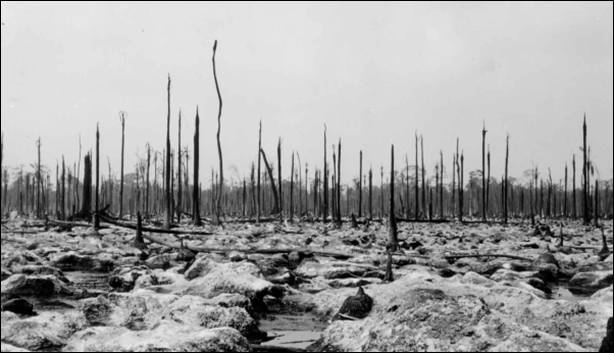
      The reason I was reminded of this is a recent discussion I had with a friend of mine. He put forth the two arguments usually encountered in topics of man and his encroachments into nature. One school of thought is that man is damaging nature to irreparable extents. The other, nature has its unique ability to reinvent itself despite the pressure it is put through. Discussing on the topic, we both concurred it is most likely that nature reinvents itself but at the cost of humanity. When nature does reinvent itself to sustain its existence, what might be left of us are 'Humanoids' - "those who cease to live and start to exist."
       Before I could come out from the mood of the chat, I came across this dialogue from the film Apocalypto:

And a Man sat alone, drenched deep in sadness.
And all the animals drew near to him and said: "We do not like to see you so sad…Ask us for whatever you wish and you shall have it."

The Man said, "I want to have good sight."
         The vulture replied, "You shall have mine."

The Man said, "I want to be strong."
        The jaguar said, "You shall be strong like me."

The Man said, "I long to know the secrets of the earth."
        The serpent replied, "I will show them to you."
And so it went with all the animals.
And when the Man had all the gifts they could give, he left..

       Then the owl said to the other animals, "Now the Man knows much and is able to do many things. Suddenly I am afraid."
       The deer said, "The Man has all that he needs. Now his sadness will stop."

       But the owl replied, "No. I saw a hole in the Man deep like a hunger he will never fill. It is what makes him sad and what makes him want. He will go on taking and taking. Until one day the world will say: ‘I am no more and I have nothing left to give.’"


        I still don't have any concrete answer to those questions of mine. But I pray I shall not have to wait for my answers till nature has nothing left to give.

Nov 7, 2011

Happiness: Time, Wealth, Success??

Picture credit: http://pixdaus.com/single.php?id=194871
          
 "But what is happiness except the simple harmony between a man and the life he leads?"
                                                     -  Albert Camus

         As a young boy, my definition of happiness was very simple - either I be allowed to read stories from 'Champak' or be allowed to watch 'Duck Tales' or 'Talespin'!!(the pre-cable network era in rural India. The now extinct 'DD Metro' was a savior back then.) I still enjoy them thoroughly and they do make me a lot happier. Then as I grew up, I was smitten by my first love - 'Poetry', to which I have stayed loyal all these years. And the affair has been getting intense as the days pass. Every time I encounter the lyrical beauty, we fly on a fulfilling journey of poetic ecstasy. From that retreat, I derive immense happiness. So, does this conclude that Happiness is a total personal perspective? Are not there any prerequisites and general prescriptions for Happiness?
        These questions did arise as I read through another of Camus' less appreciated work - 'A happy death'. It was his first novel, but the last to be published. It is said he was twenty when he wrote this. But it was published after a decade of his death, about forty years after being written. The work has been criticized by the learned as being inferior and a mere preparation for his magnum opus - 'The Stranger'. (In a lighter vein, maybe the critics were expecting to find the great 'Noble' philosopher Camus in the 20 year old 'rebel' lad;-)) Though rated inferior literally, to me, it appears philosophically as fascinating as 'The Stranger'.
         Well, leaving the critics, I shall come back to the question of happiness. To get perspectives on track, 'A happy death' tells the story of Patrice Mersault, a working man who fails to be happy while struggling to make ends meet with meaningless work occupying his time. He meets Roland Zagreus, a million dollar cripple who tells Mersault that "....there's a kind of spiritual snobbery in certain "superior beings" who think that money isn't necessary for happiness. Which is stupid, which is false, and to a certain degree cowardly... It takes time to be happy. A lot of time. Happiness, too, is a long patience. And in almost every case, we use up our lives making money, when we should be using our money to gain time...." Mersault later murders Zagreus, and takes all his wealth(a whooping 2 million!!), apparently with Zagreus' consent since his crippled state blocks his own happiness, and the rich Mersault begins his quest of happiness. He tries travel, that fails; he lives with three young women in "the House above the World," but that fails. Everybody is in the pursuit of happiness. Yet Mersault retreats to a solitary life. He marries a pleasant woman he does not love, buys a house in a village by the sea, and moves in. Mersault achieves a degree of happiness but this is short lived since he becomes ill and dies his "happy death."
            Fine, now is the question time. Money and time are prerequisites to achieve happiness? Was this Camus' conclusion? Or does he indicate a different conclusion at the climax? Money is indeed a necessity as long as we are part of the society. Its money that satisfies hunger, sustains life, and gets us a place of dignity. But how much of it will do? We are the wealthiest generation on earth, I suppose, considering our GDPs and the Financial Capital we generate. (Though the socio-economic inequlities are at their Zenith, I am talking in gross terms of the present global generation as a whole.) But are we living through the happiest phase on earth? I find it pertinent to quote Richard Layard, the British Economist, from his book 'Happiness: Lessons from a new Science' - "There is a paradox at the heart of our lives. Most people want income and strive for it. Yet as Western societies have got richer, their people have become no happier."
       The next ingredient - 'Time', but who on earth has time these days, except for the lazy loafing souls? Going by Zagreus' assertion, maybe in the fast paced world of ours, if anyone feels deprived of happiness its because they have robbed themselves of time. Again, there are counter arguments to this, as are for everything that exists. But how valid are these remarks? 
          The achievement of things that we value and our noteworthy accomplishments render us a sense of happiness. So another significant dimension of happiness is our perceived notion of success. Stories of success are pouring in every day. The opportunities offered in our globalized society have no parallel. More are our chances of striking gold in the pursuit of whatever we take up. Has all this contributed to achieve a better gross happiness index? Or are we burdened by the guilt of ascending to the throne on corpses of the less advantaged? 
         Looking from another angle, How original is our perception of Success? Prof.John McMurtry in his groundbreaking research work "Unequal Freedoms: The Global Market as an ethical system" sheds light on how perceptions of success are seldom our own. We are fed a value system which asserts we 'must' compete in the global marketplace and its a closed system of choice. He observes 'All people enact its prescriptions as presupposed norms of what they should do. All assume its value designations and value exclusions as given. They seek only to climb its ladder of available positions to achieve their deserved reward as their due. Lives are valued, or not valued, in terms of the system's differentials and measurements....' Is their space for happiness in this system? Forget it, does a concept called 'happiness' exist here or is it that we are being unconsciously fed notions of happiness too!? I don't know or maybe I don't understand.
         To find solace, I shall return back to Camus' Mersault as he, in the course of the novel, says - "You make the mistake of thinking you have to choose, that you have to do what you want, that there are conditions for happiness. What matters -- all that matter is -- is the will to happiness, a kind of enormous, ever-present consciousness. The rest women, art, success -- is nothing but excuses…." I put all the mess aside and think its time to heed to Buddha - "To be happy, rest like a tree". Is the tree happy? Ask not me, but the Gutama Buddha my friend. I only find it safe and convenient to assume so. My maxim for happiness is quite simple. I modify the phrase of Leo Tolstoy to describe it - "If you want to be happy, be; and never impede others freedom to be."

         "In a silence violated only by the silky sounds of the sky, the night lay like milk upon the world. Mersault walked along the cliff, sharing the night's deep concentration. Below him the sea whispered gently. It was covered with velvety moonlight, smooth and undulating, like the pelt of some animal. At this hour, Mersault's life seemed so remote to him, he felt so solitary and indifferent to everything and to himself as well, that it seemed to him he had at last attained what he was seeking, that the peace which filled him now was born of that patient self-abandonment he had pursued and achieved with the help of this warm world so willing to deny him without anger." 
                                                                 - Albert Camus('A Happy Death')


Oct 15, 2011

The Absurdity of Existence.


"At the very end of his long effort measured by skyless space and time without depth, the purpose is achieved. Then Sisyphus watches the stone rush down in a few moments toward that lower world whence he will have to push it up again toward the summit. He goes back down to the plain."
                                                  - Albert Camus ('The Myth of Sisyphus')

           Why are we living? Should our existence have a meaning attached to it? The purpose of life has been the question of concern in religion and philosophical studies for over millenniums. Most of the religions and their derived thoughts prescribe Mukti or Nirvana as the ultimate purpose of living. At times it gets complicated to comprehend the meaning of these terms in their entirety. Stripping ourselves of all the acquired knowledge, let us put into question what our instincts and experiences tell us. Have not we at times had the gut feeling that all that we are doing is simply meaningless when ripped bare to its essentials? In moments of insight and illumination, sometimes does strike the haunting 'Absurdity of Existence'.
        The purpose of life, we are usually taught, is to be righteous. Righteous in speech, action and all spheres of living. A great lesson indeed because righteousness leads to dispersion of peace and that shall solve a lot of issues worldwide. (The classification of righteous action itself is an issue with contradictory leanings in contemporary world!) Though righteousness is a virtue in its own right, is that all the purpose of this grand experiment of living?
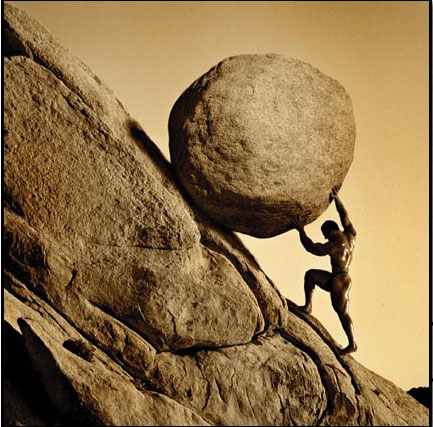
    Within each of us, maybe we can recognize a Sisyphus, the Greek mythological king who was compelled to roll an immense boulder up a hill, only to watch it roll back down, and to repeat this throughout eternity. While a few of us curse ourselves for getting into the monotonous nature of the seemingly meaningless activity, there are others who enjoy it. Maybe the latter can find in them the Malayali folklore character Naranath Branthan who rolled big stones up the hill and let them roll down back, laughing thunderously on seeing this sight!
       What interests me in these characters is the seemingly absurdity of the task they carry on and their perception towards it. While to Sisyphus, it was an act of compulsion as that was his punishment; but to Naranth it was an eccentric habit and he seemed to enjoy the task! Well the interpretations on these characters is as varied as are the number of interpreters. To me, the absurdity of their tasks seems to be a point well made on the futility of human attempts to achieve permanence in light of life's transience.  There exists a grandeur in the absurdity. In Naranath Branthan,  I find the 'Absurd man' whom Camus describes thus - "He who, without negating it, does nothing for the eternal. Not that nostalgia is foreign to him. But he prefers his courage and his reasoning. The first teaches him to live without appeal and to get along with what he has; the second informs him of his limits. Assured of his temporally limited freedom, of his revolt devoid of future, and of his mortal consciousness, he lives out his adventure within the span of his lifetime."
       I do not claim to know the purpose underlying our existence nor do I know if one actually exists. But is a purpose always required to drive life? Even if a purpose is decided upon, how long do we cling to it? I have no answers but maybe I do not need the answers! I share Gibran's view on Nirvana in life - “Yes, there is Nirvana; it is in leading your sheep to a green pasture, and in putting your child to sleep, and in writing the last line of your poem.”
      Beyond the pursuit of purpose, there is a reality to life. It shall come to an end. All accomplishments shall fade out with time. Nature shall always have the last laugh. No, I am not being pessimistic. From recognizing these facts does arise an optimism - The optimism that life is not momentary existence but life is the joy of living. Thoreau did strike a chord when he coined the phrase 'to cease to exist and start to live'. Maybe existence has its absurdities, but not living!

"I leave Sisyphus at the foot of the mountain! One always finds one's burden again. But Sisyphus teaches the higher fidelity that negates the gods and raises rocks. He too concludes that all is well. This universe henceforth without a master seems to him neither sterile nor futile. Each atom of that stone, each mineral flake of that night filled mountain, in itself forms a world. The struggle itself toward the heights is enough to fill a man's heart. One must imagine Sisyphus happy."
                      - Albert Camus ('The Myth of Sisyphus')

Jun 29, 2011

"Reductio ad absurdum": A Mathematician's delight & a Philosopher's quest!!

   Philosophy & Mathematics share such an extraordinary rapport that they have shaped up civilizations, spurred up intellectual revolutions and at times together have surmounted the seemingly unsurmountable.
   Despite arguments that Philosophy & Maths(Science in general) are at loggerheads with each other in terms of perspectives & interpretations, to a lot of us with interdisciplinary interests, they are different faces of the same coin. In the words of Will Durant - "Philosophy seems to stand still, perplexed, but only because she leaves the fruits of victory to her daughters the Sciences, and she herself passes on divinely discontent, to the uncertain & unexplored."
  One such aspect of immense interest in both the disciplines is "Reductio ad absurdum"(Latin for 'reduction to the absurd'). Its a form of argument in which a proposition is disproven by following its implications logically to an absurd consequence. Familiar to students of Mathematics as "Proof by contradiction".
  Now the beauty of this form of argument is two folded. One in the perspective of Math and the other in the light of Philosophy.
  To illustrate the Math perspective, Hardy does it best in his famous statement - " Reductio ad absurdum, which Euclid loved so much, is one of Mathematician's finest weapons. It is a far finer gambit than any chess gambit; A chess player may offer the sacrifice of a pawn or even a piece, but a Mathematician offers the game." In the method of proof by contradiction, the very first statement would be to assume what is to be proved true as false!! Like if you had to prove the number of primes was infinite, you start by assuming the number of primes is finite(crazy!) and then prove the assumption to be false(crazier!). Maybe rather than being a method of proof, it is a method of disproving the false and thereby acting as an implied proof of the truth!! There lies the beauty for the beholder!!
  In the light of Philosophy, the argument has rendered a lot of interesting twists in the tale. Consider Neils Bohr's statement: "The opposite of every great idea is another great idea." Carl Sagan used a reductio ad absurdum argument to counter this claim. If this statement is true, then it would certainly qualify as a great idea - it would automatically lead to a corresponding great idea for every great idea already in existence. But if the statement itself is a great idea, its opposite must also be a great idea. The original statement is disproven because it leads to an absurd conclusion: that an idea can be great regardless of whether it is true or false. Now what is true and what is false has been Philosopher's quest for over centuries. But how the approach of argument renders interpretation is interesting.
  "If the windows of perception are cleansed, everything would appear as it is - infinite.
                                                                                            - William Blake"