Oct 15, 2011

The Absurdity of Existence.


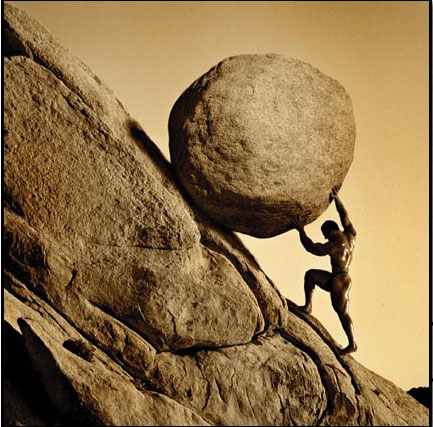
"At the very end of his long effort measured by skyless space and time without depth, the purpose is achieved. Then Sisyphus watches the stone rush down in a few moments toward that lower world whence he will have to push it up again toward the summit. He goes back down to the plain."
                                                  - Albert Camus ('The Myth of Sisyphus')

           Why are we living? Should our existence have a meaning attached to it? The purpose of life has been the question of concern in religion and philosophical studies for over millenniums. Most of the religions and their derived thoughts prescribe Mukti or Nirvana as the ultimate purpose of living. At times it gets complicated to comprehend the meaning of these terms in their entirety. Stripping ourselves of all the acquired knowledge, let us put into question what our instincts and experiences tell us. Have not we at times had the gut feeling that all that we are doing is simply meaningless when ripped bare to its essentials? In moments of insight and illumination, sometimes does strike the haunting 'Absurdity of Existence'.
        The purpose of life, we are usually taught, is to be righteous. Righteous in speech, action and all spheres of living. A great lesson indeed because righteousness leads to dispersion of peace and that shall solve a lot of issues worldwide. (The classification of righteous action itself is an issue with contradictory leanings in contemporary world!) Though righteousness is a virtue in its own right, is that all the purpose of this grand experiment of living?
    Within each of us, maybe we can recognize a Sisyphus, the Greek mythological king who was compelled to roll an immense boulder up a hill, only to watch it roll back down, and to repeat this throughout eternity. While a few of us curse ourselves for getting into the monotonous nature of the seemingly meaningless activity, there are others who enjoy it. Maybe the latter can find in them the Malayali folklore character Naranath Branthan who rolled big stones up the hill and let them roll down back, laughing thunderously on seeing this sight!
       What interests me in these characters is the seemingly absurdity of the task they carry on and their perception towards it. While to Sisyphus, it was an act of compulsion as that was his punishment; but to Naranth it was an eccentric habit and he seemed to enjoy the task! Well the interpretations on these characters is as varied as are the number of interpreters. To me, the absurdity of their tasks seems to be a point well made on the futility of human attempts to achieve permanence in light of life's transience.  There exists a grandeur in the absurdity. In Naranath Branthan,  I find the 'Absurd man' whom Camus describes thus - "He who, without negating it, does nothing for the eternal. Not that nostalgia is foreign to him. But he prefers his courage and his reasoning. The first teaches him to live without appeal and to get along with what he has; the second informs him of his limits. Assured of his temporally limited freedom, of his revolt devoid of future, and of his mortal consciousness, he lives out his adventure within the span of his lifetime."
       I do not claim to know the purpose underlying our existence nor do I know if one actually exists. But is a purpose always required to drive life? Even if a purpose is decided upon, how long do we cling to it? I have no answers but maybe I do not need the answers! I share Gibran's view on Nirvana in life - “Yes, there is Nirvana; it is in leading your sheep to a green pasture, and in putting your child to sleep, and in writing the last line of your poem.”
      Beyond the pursuit of purpose, there is a reality to life. It shall come to an end. All accomplishments shall fade out with time. Nature shall always have the last laugh. No, I am not being pessimistic. From recognizing these facts does arise an optimism - The optimism that life is not momentary existence but life is the joy of living. Thoreau did strike a chord when he coined the phrase 'to cease to exist and start to live'. Maybe existence has its absurdities, but not living!

"I leave Sisyphus at the foot of the mountain! One always finds one's burden again. But Sisyphus teaches the higher fidelity that negates the gods and raises rocks. He too concludes that all is well. This universe henceforth without a master seems to him neither sterile nor futile. Each atom of that stone, each mineral flake of that night filled mountain, in itself forms a world. The struggle itself toward the heights is enough to fill a man's heart. One must imagine Sisyphus happy."
                      - Albert Camus ('The Myth of Sisyphus')

Oct 7, 2011

Absolute reverence..


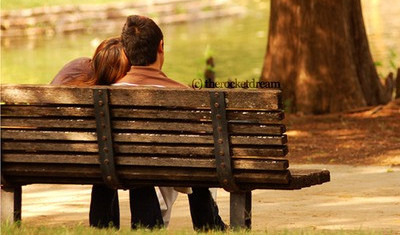
In solitude from the world, under the shade of a tree
Sat they on a sunny day, when they were free.

In one another, had they found a soothing rhyme
Thus did friendship blossom between them with time.

As she rested her head on his broad shoulder
Across her shoulder went his hand and held her.

Her fingers, in silence, ran through the hair on his head.
Disturbing her subtle calmness; to her, questions he fed -

"Why does it seem you don't express all that you feel?
No barriers in our friendship, wasn't that the deal?"

Dwelling deep in his eyes, did she look for trust
Assuming its existence, she spoke, clearing the dust -

"A girl when voices her feelings, in this society
 Is like the priest caught in the ritual of variety.

A priest offering prayers to a deity in procession
Not just that, he is fed a mouthful of poison.

If swallowed, all his life would end in vanity.
If split out, he ruins his and the deity's dignity.

Yet he is asked to sing hymns in the Lord's praise,
Voice their pains and seek pleasure for the entire race.

Thus is it when we are asked to express ourselves.
Voices crushed, we are left with only tears and sighs.

Caged freedoms, Broken promises, Abandoned dreams,
Swollen wounds, Masked pains and Fake smiles.

If truth be expressed, it reveals the transience of identity.
If kept to myself my voices, doubted is my fidelity."

He could sense her moist eyes as tears rolled on to his shoulder.
Reassuring his presence, in subtle calmness, he gently held her.

Failing to find words to express himself, he surrendered to silence.
She had poured her heart into his soul in absolute reverence...

Oct 4, 2011

A pick of Zen stories - 2


Like the little stream
Making its way
Through the mossy crevices
I, too, quietly
Turn clear and transparent.

-From "Dewdrops on a Lotus Leaf: Zen Poems of Ryokan"

1. Moving mind

Two men were arguing about a flag flapping in the wind.

“It’s the wind that is really moving,” stated the first one.

“No, it is the flag that is moving,” contended the second.

A Zen master, who happened to be walking by, overheard the debate and interrupted them.

“Neither the flag nor the wind is moving,” he said, “It is MIND that moves.”

2. Present Moment

A Japanese warrior was captured by his enemies and thrown into prison. That night he was unable to sleep because he feared that the next day he would be interrogated, tortured, and executed. Then the words of his Zen master came to him, “Tomorrow is not real. It is an illusion. The only reality is now.” Heeding these words, the warrior became peaceful and fell asleep.

3. Mastering technique.

After having won many archery contests, the town champion went to the Zen master.

I am the best of all – he said. – I didn’t study religion, never sought help from the monks, and succeeded in becoming the finest archer in the whole region. I heard that, for a time, you were the best archer in the region, and ask you: was it necessary to become a monk in order to learn to shoot?

No – replied the Zen master.

But the champion was not satisfied: he took an arrow, placed it in the bow, fired it and hit a cherry which was very far away. Smiling, as if to say: "you might have saved your time, devoting yourself only to technique." And he said:

I doubt whether you could do that.

Without looking in the least bit worried, the master went inside, fetched his bow, and began to walk towards a nearby mountain.
On the way, there was an abyss which could only be crossed by an old bridge made of rotting rope, and which was almost collapsing.
The Zen master went to the middle of the bridge, took his bow and placed an arrow in it, then aimed at a tree on the far side of the precipice, and hit his target.

Now it is your turn – he kindly told the young man, as he returned to firm ground.

Terrified as he gazed down at the abyss below his feet, the young man went to the spot and fired, but his arrow veered wide of the mark.

4. Egotism

The Prime Minister of the Tang Dynasty was a national hero for his success as both a statesman and military leader. But despite his fame, power, and wealth, he considered himself a humble and devout Buddhist. Often he visited his favorite Zen master to study under him, and they seemed to get along very well. The fact that he was prime minister apparently had no effect on their relationship, which seemed to be simply one of a revered master and respectful student.

One day, during his usual visit, the Prime Minister asked the master, “Your Reverence, what is egotism according to Buddhism?” The master’s face turned red, and in a very condescending and insulting tone of voice, he shot back, “What kind of stupid question is that!?”

This unexpected response so shocked the Prime Minister that he became sullen and angry. The Zen master then smiled and said, “This, Your Excellency, is egotism.”

5. Books

Once there was a well known philosopher and scholar who devoted himself to the study of Zen for many years. On the day that he finally attained enlightenment, he took all of his books out into the yard, and burned them all.

6. Gift of Insults

Near Tokyo lived a great Samurai, now old, who decided to teach Zen Buddhism to young people.

One afternoon, a warrior – known for his complete lack of scruples – arrived there. The young and impatient warrior had never lost a fight. Hearing of the Samurai’s reputation, he had come to defeat him, and increase his fame.

All the students were against the idea, but the old man accepted the challenge.

All gathered on the town square, and the young man started insulting the old master. He threw a few rocks in his direction, spat in his face, shouted every insult under the sun – he even insulted his ancestors.

For hours, he did everything to provoke him, but the old man remained impassive. At the end of the afternoon, by now feeling exhausted and humiliated, the impetuous warrior left.

Disappointed by the fact that the master had received so many insults and provocations, the students asked:
How could you bear such indignity? Why didn’t you use your sword, even knowing you might lose the fight, instead of displaying your cowardice in front of us all?

If someone comes to you with a gift, and you do not accept it, who does the gift belong to? – asked the Samurai.
He who tried to deliver it – replied one of his disciples.

The same goes for envy, anger and insults – said the master.

7. I do not know.

The emperor, who was a devout Buddhist, invited a great Zen master to the Palace in order to ask him questions about Buddhism.

“What is the highest truth of the holy Buddhist doctrine?” the emperor inquired.

“Vast emptiness… and not a trace of holiness,” the master replied.

“If there is no holiness,” the emperor said, “then who or what are you?”

“I do not know,” the master replied.

8. Desperate

The son of a master thief asked his father to teach him the secrets of the trade. The old thief agreed and that night took his son to burglarize a large house. While the family was asleep, he silently led his young apprentice into a room that contained a clothes closet. The father told his son to go into the closet to pick out some clothes. When he did, his father quickly shut the door and locked him in. Then he went back outside, knocked loudly on the front door, thereby waking the family, and quickly slipped away before anyone saw him. Hours later, his son returned home, bedraggled and exhausted. “Father,” he cried angrily, “Why did you lock me in that closet? If I hadn’t been made desperate by my fear of getting caught, I never would have escaped. It took all my ingenuity to get out!” The old thief smiled. “Son, you have had your first lesson in the art of burglary.”

9. Holy man

Word spread across the countryside about the wise Holy Man who lived in a small house atop the mountain. A man from the village decided to make the long and difficult journey to visit him.

When he arrived at the house, he saw an old servant inside who greeting him at the door.

“I would like to see the wise Holy Man,” he said to the servant.

The servant smiled and led him inside. As they walked through the house, the man from the village looked eagerly around the house, anticipating his encounter with the Holy Man.

Before he knew it, he had been led to the back door and escorted outside. He stopped and turned to the servant,

“But I want to see the Holy Man!”

“You already have,” said the old man. “Everyone you may meet in life, even if they appear plain and insignificant… see each of them as a wise Holy Man. If you do this, then whatever problem you brought here today will be solved.” 

10. How grass and trees become enlightened?

During the Kamakura period, Shinkan studied Tendai six years and then studied Zen seven years; then he went to China and contemplated Zen for thirteen years more.

When he returned to Japan many desired to interview him and asked obscure questions. But when Shinkan received visitors, which was infrequently, he seldom answered their questions.

One day a fifty-year-old student of enlightenment said to Shinkan: “I have studied the Tendai school of thought since I was a little boy, but one thing in it I cannot understand. Tendai claims that even the grass and trees will become enlightened. To me this seems very strange.”

“Of what use is it to discuss how grass and trees become enlightened?” asked Shinkan. “The question is how you yourself can become so. Did you even consider that?”

“I never thought of it that way,” marveled the old man.

“Then go home and think it over,” finished Shinkan.

(Why always limit the number of stories to 10??;-) This time I will break the routine...)

11. Writing a poem

A well-known Japanese poet was asked how to compose a Chinese poem.

“The usual Chinese poem is four lines,” he explains. “The first line contains the initial phase; the second line, the continuation of that phase; the third line turns from this subject and begins a new one; and the fourth line brings the first three lines together. A popular Japanese song illustrates this:

Two daughters of a silk merchant live in Kyoto.

The elder is twenty, the younger, eighteen.
A soldier may kill with his sword.
But these girls slay men with their eyes.


More Stories: A pick of Zen Stories - 1

Sep 27, 2011

The dichotomy of Decision making.


"To be, or not to be: that is the question
Whether 'tis nobler in the mind to suffer
The sling and arrows of outrageous fortune,
Or to take arms against a sea of troubles
And by opposing end them.
                 - Shakespeare (in Hamlet)"

         In an unconscious way, choices we make today determine our decisions tomorrow. What we fail to realize at times is before we take a decision, its long been decided at the sub conscious level when our persual of the objective is intense and all pervasive. A lot of our perceptions and attitudes get aligned towards the decision we are headed to. Life just takes us to the point when that is the only choice preferred.
        Not always are we as lucky. Most of the times we fail to negotiate what is the objective we yearn to pursue. That is when the dichotomy of decision making presents itself to us in all its grandeur of confusion!! Its not easy to discover what is the purpose of a persual in the early stages. Sometimes, only when the pursuit is near completion do we exactly realize the purpose. Maybe thats the way of life.
    Decision making is like the problem of optimization theory. Any student of mathematical optimization might appreciate the beauty of the analogy. In any method of constrained optimization, its the technical constraints and sign restrictions that determine the feasibility and optimality of the solution in connection with the objective function. All issues of decision making boil down to this. The feasible solutions are found with considerable ease. But its the test of optimality that posses the biggest challenge. In arriving at a decision, though feasible options are presented after a few sessions of introspection and brain storming, its the challenge to pick the optimal one and tailor it to suit our needs that is a test of character. The time when decision making gets gritty and gruesome.
      Priorities have to be weighed. Relationships, Career advancements, Opportunities, Scope for pursual of interests - My god! the list of constraints to be adhered itself turns to be an overhead at times. Sometimes we may wish to break away from all the constraints and just fly free. But this overhead is what adds beauty to the process of decision making. Once an optimal solution is arrived at after due considerations to individual specific constraints, there is a relaxing satisfaction. (I agree, it does not stay long in our transient world;-). But still for the moment, a soothing relaxation does exist.)
       Too much of analysis spoils the beauty of anything and everything. The devil is in the details. Once we arrive at a decision, it is better we do not go back frequently to reasses its worth. Suggestions and advices, the most freely available drugs in the market, when do not take into account our position and percetions push us to the peak of pessimism. A lot of criticism is always in stock, for the cynics have nothing better to offer! Though constructive criticism is welcome, sometimes its the freedom to explore, falter, rediscover and learn that adds life to the process. All decisions ultimately help us learn and to learn is to live.
       The world is never seen identically by any two pairs of eyes. So its not alwas necessary that our decisions are agreed and appreciated by our fellow beings. Its our conviction to stand by the decision we take that defines the consequences of it. None of us are inherently perfect. All our decisions can be dynamic. We might realize its non feasibility and modify it to suit our needs but only owing to self realization would be better rather than owing to persual or pressure.
     When a good friend said - "the arrival at a decision limits the choice of freedom", I got into introspection only to infer that decisions are not always necessary. Maybe we tend to over decide;-) Though taken, they need not be all pervasive. Its true that when we pick one end of a stick we pick up the other end too. But do we take it for granted that we should never place the stick back?? If the stick is either too lengthy or heavy or not long enogh, I would prefer to place it back and try find a better one that suits me!!

Sep 14, 2011

Images..

These are images. Those are images.
Here are they and there too.
Within us are filled these images
Without them we woo.
Do they mean something? Or should they?
Their description lies in our perception.
To some are they illusions.
To others a part of existence.
Unable to sense a difference.
Masking identities, seeking accomplishments -
Get blurred these images.
Truly unabated, if is the spirit of exploration
How come all over are reservations?
Time tolls in pursuit - Clearer our images.

Sep 9, 2011

Strolling with a friend..

Dear friend.,
      This is a leisurely letter to you. Like taking a stroll in a garden during a moist morning, just walk through this by my side. As I write to you my thoughts about friendship, the feeling of your presence soothes my soul. Friendship, to me, is not a choice though most of them claim it to be. I did not choose you as my friend. It just happens through the twist of time. Sometimes owing to our luck, we just meet the right person at the right time and a chord of intimacy strikes. You can call it coincidence or destiny. I would prefer the term 'Metaphysics', well the essence remains the same, whatever we choose to call it.
        Man is a social animal and to boost his social identity he needs companionship. Thats one of the reasons we all have a family. The extended family in our society is what becomes our friends circle. Well, even in the family, there is a lot of friendship. In the affection that Mom showers, in the naughtiness of the bro who pulls your leg, in the elegance of the elder sister who defends all your actions - isn't there a bit of friendship?
"Probably no man ever had a friend he did not dislike a little."
                                                           - Ed Howe
        As many friends we have, so many different set of attitudes and opinions. No two friends always end up agreeing on all issues they discuss. So are we. There is a beauty in disagreement. Don't you agree? With every mistake of mine, you too learn along with me. So is the case when you commit a mistake. When either of us makes a grave mistake, takes a wrong decision, breaks up in haste, I pray the other to standby, take it all in grace and let the moment just pass by. We shall need one another the very next moment. Let us put behind the rightness and wrongness of the bygone issues and stand for one another. It doesn't mean to defend each other's mistakes, but I pray we stay by each other in the process of correcting those mistakes, in the process of suffering its consequences. You need not take any responsibility of my life, neither do I of yours. But we shall lend to ourselves a shoulder to lean on in times of despair.

       You have a good day at office, read something interesting, watched a nice movie, had a spat with your loved one, want to share the joy, call me up. I too shall do the same when I have something to share. Let us not limit it to joy. I shall rely on you to be my emotional shock absorber, during times of distress and outbursts. You too are free to use me as your shock absorber. But let us not forget to never evade the limits. Everything of this shall be optional my friend, "no strings attached!!";-) Yeah, it happens at times when one of us overlooks the other's concerns, we are friends and have all the right to state it straight forward on the event of such an overlook. Let us not hesitate in conveying things, which if left without communicating may lead to irritation.

     There might be times when some sensibilities can't be told. I do believe both of us are mature enough to understand the untold sensibilities. If any of us fail to, the other is generous enough to pardon the dumbness of the other. Yet, let this not be an excuse between us.
        And the most important thing as I see it, we shall have differences. My approach to life and your approach to life can never be identical at all stages. Let us agree to disagree with due respects. We shall keep ourselves open to constructive reflections but let us refrain from being each others judge. Let there be discussions, never leading to arguments. I pray this friendship of ours shall always stand on the right and freedom to voice opinions, avoid undue criticism.
       Of course, all good things must come to an end. So shall our friendship. The end might be when either of us switches professions, moves out of town, gets into a relationship, flies abroad, ceases to exist or whatever.  Lets face it with dignity. If there arises a feeling of rekindling the relationship, and both of us are open to it, then let us bury the past and get along as long as it flows.
     Before I end the letter, here are lines that aptly describe what we have been cherishing-
Your friend is your needs answered.
He is your field which you sow with love and reap with thanksgiving.
And he is your board and your fireside.
For you come to him with your hunger, and you seek him for peace.

When your friend speaks his mind you fear not the "nay" in your own mind, 
nor do you withhold the "ay".
And when he is silent your heart ceases not to listen to his heart;
For without words, in friendship, all thoughts, all desires, all expectations are born and shared, with joy that is unacclaimed.
When you part from your friend, you grieve not;
For that which you love most in him may be clearer in his absence,
as the mountain to the climber is clearer from the plain.
And let there be no purpose in friendship save the deepening of the spirit.
For love that seeks aught but the disclosure of its own mystery 
is not love but a net cast forth:
and only the unprofitable is caught.

And let your best be for your friend.
If he must know the ebb of your tide, let him know its flood also.
For what is your friend that you should seek him with hours to kill?
Seek him always with hours to live.
For it is his to fill your need, but not your emptiness.
And in the sweetness of friendship let there be laughter, and sharing of pleasures.
For in the dew of little things the heart finds its morning and is refreshed.
          - Khalil Gibran.

        You feel all this is too very vague, idealistic and impractical? My friend, dreams are always like that and our lives have always been the pursuit of dreams.
 With love.,
Your friend.
   

Sep 4, 2011

The hidden river


In the crust of the earth, unseen and unheard -
Flows the hidden river -
She is in the moist running through soil.
In the soul of man, unperturbed and unperceived -
Flows the hidden river - 
She is in thoughts meandering through conscience.
No complaints, she is not in the troubled waters.
Nor does she have a destination to reach in time.
Hers is a journey never anticipating an end,
She is in ecstasy, hers is a mindless flow.
Defying all logics and reasons, she stays hidden.
Futile are attempts to give her an identity,
She ceases to be the identified, Renewing ever
Flows the hidden river!