Showing posts with label Opinion. Show all posts

Oct 20, 2014

A daughter in confusion.


Picture Credit: http://wp.production.patheos.com/
Mom,
      I write this to you in a state of confusion. You have always been my never failing support system - always there for me. Especially after Dad expired, you have been both Mom and Dad to me.
      Now that I am 25 and as most Indian moms in this situation, you are busy looking at marriage alliances for me. But a thought haunts me deep down in my heart. Despite the optimism you have imbibed in me, I am cynical in this matter.
     I know most of the alliances you have looked till now have rejected us because in most cases either I am more qualified than the guy or I am professionally better placed than him. Despite all the claims of modernity of our society, we still expect the wife to be inferior to the husband in certain parameters as such. To generalize one profession to be better than another totally unrelated profession is at best ignorance. How fair to compare a doctor and a teacher and conclude all doctors are professionally better placed than teachers? Or is it actually true in a society which values professions on subjective perspectives and social opinions?
      Well, though that does trouble me, it is not the cause of the trauma that I undergo. These perspectives I hope will gradually change with the society realizing that qualifications and professions are not true measures to assess a person. Well for that matter, nothing is a precise measure to assess a person!
      The larger contradiction that haunts me is why is that only a girl has to worry about leaving behind her family and going to her husband's place? Do boys ever undergo the trauma of this thought whenever the issue of their marriage is raised? To say this is how it works in a patrilineal society is no cure to the agony of my heart.
       Every time you talk of my marriage, it haunts within me that I have to leave you - my mom, the house I grew up in - my home.... Can't I get married and yet stay back with you? Or still better, can't two entire families, as the circumstance be, come together in a marriage instead of two individuals coming together and only one of them sacrificing a lot? I agree such things do happen today, but only if the guy and the family are considerate enough. But how do we girls know if they are considerate enough? Talk to them, ask them, put your point across, communicate... Hahaha!!!
      Mom, will there ever be a day when girls like me staring into the entanglement of uncertainty will be spared of the trauma of the thought of leaving behind their families just because a decision made them part of another family? A decision that very subtly deprives girls of a lot of what is inexplicable.
Or Mom, am I just being a frustrated girl whose marriage has not happened yet and who unnecessarily thinks too much?

Yours loving,
A daughter in confusion.
Mar 27, 2013

Ecstasy of a poem

Picture Credit: vacacionista.wordpress.com
 "The meaning and ecstasy of a poem are more in the lines which are read, than in the lines which are written."

Jan 8, 2013

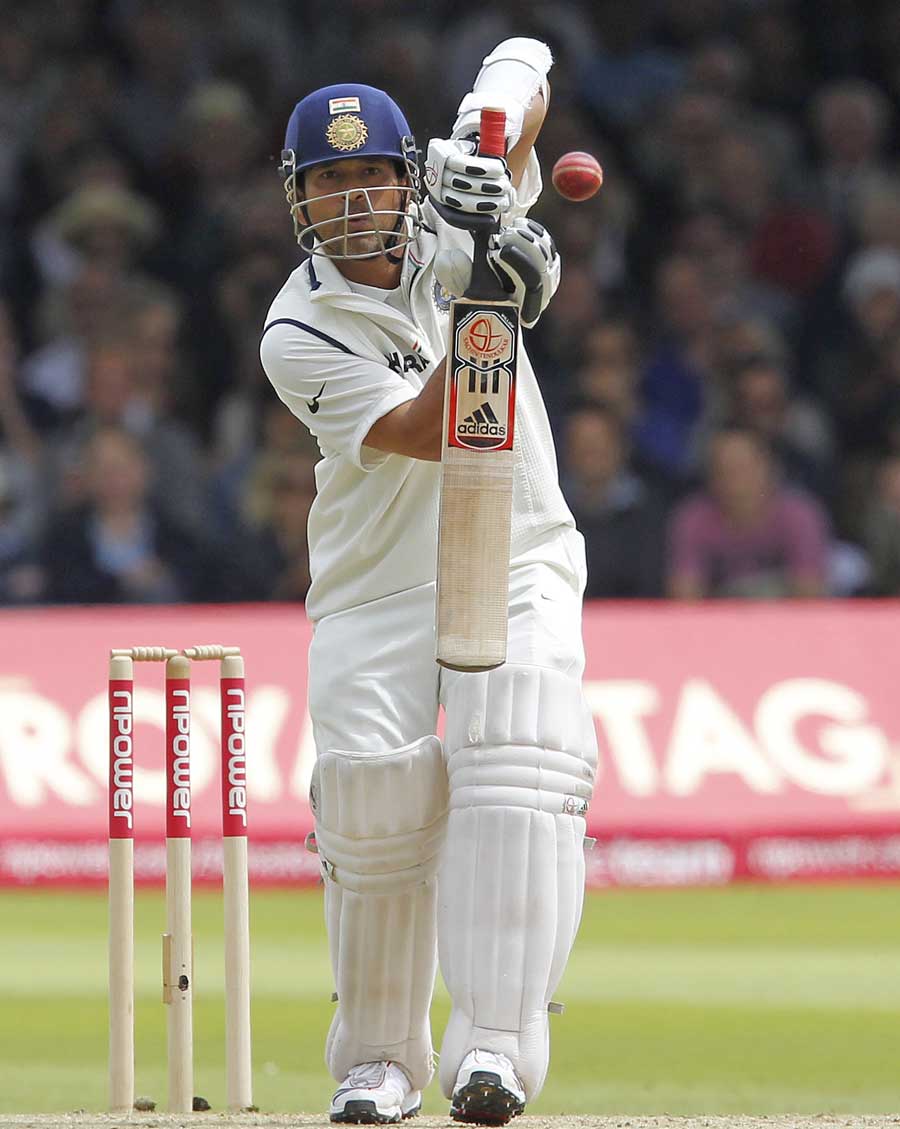
Sachin, Jaane ki zid na karo...

          
     Ever wondered if truth is actually a dream? Ever found yourself in a position where you desperately wanted the fact to be confirmed false and simply kept waiting for it to happen, defying all logic? Yeah, we all would have experienced these in our childhood. But I found myself in similar situations over the past month. Not that my childhood is over, I am still a child in his 3rd decade!! But despite the fact of Tendulkar's retirement from ODI, it took almost one month, and an entire India-Pakistan series for me to half heartedly accept the fact.
       With the retirement of Tendulkar from ODIs, a part of my childhood is at jeopardy. He set his foot into ODIs in 1989, the year I was born. His first ODI century was hit in 1994, the year I entered schooling. And from then on, there has been no stopping. All my schooling in cricket was watching Tendulkar. Watching him hit those straight drives with wide open eyes, has to be one of the most cherished moments of my childhood. To me, Tendulkar resonates with my own dreams of victory and now I am anxious if my dreams will be orphaned?
      Our only family TV show back then, was when Tendulkar held fort. Mom and Dad, though were not cricket crazy, simply stopped in front of the TV screen to catch a glimpse of the phenomenon that brought life and joy to millions of sports lovers the world over. The agile Tendulkar, though short was fast and smart enough to fox the fielding side to pick a single though the ball remained within the crease. This one fact was something that always left my dad awe struck.
       I vividly remember that World cup Indo-Pak encounter in 2003. My Dad, never cricket crazy, got a call and he replied he could not come till Tendulkar stood strong in the crease! That innings was magical. That six into the stands set up the successful Indian chase. We talk of chases and we don't talk of that mammoth chase against Australia! He stood like a Gladiator that day, anchored the entire Indian batting line up and to every cricket fan, that was a victory in defeat! Chasing 350 against one of the finest teams in contemporary times, Tendulkar scored a legendary 175(141 balls) and proved why he was the master of the craft. Who in India will forget the first 200 in ODIs?
      Why only the milestones? Moments of exuberant cricketing genius fill my memory. That daring attempt to direct the ball over the slip cordon along its way to the fence, that ability to play lofted shots along the spin over the bowler, that flick of the wrists to guide the ball on the leg side, and my personal favorite - the straight drive. Oh, what maturity in that batting of his! That movement of his eyes as he read the ball pacing towards him, that sweet sound when the ball was hit from the middle of his bat, that humility in his celebration and the agony in us when the ball knocked off his stumps - Nahi boolunga mein, jab tak hai jaan, jab tak hai jaan!
      The tragedy of cricket in our country is that it is not a sport. As they say, it is more of a religion - a religion which thankfully remains above communalism. But is prone to most of the flaws that religions are subject to in India - extreme admiration, unreasonable loyalty, baseless beliefs, illogical expectations, bigotry. Every admirer of sports knows victory and defeat are inevitable to any mortal. But to most Indians, Tendulkar was always looked up as an exception. To us, he was the God of Cricket. Every time he took guard, we wanted him to score another century. If anyone has betrayed Tendulkar the most, then it is we, his own country men. We denied him any concession, at least those chances of failure, every mortal is entitled to. Yet, the great man was the most unlikely to loose cool and kept us entertained and educated us with his skills on field and behavior off field. We mounted such immense pressure on him that one single measure of his greatness lies is his composure, the finest among any contemporary sportsmen.
        Sachin's game was not one of passion, but of vigorous passion. There was energy to it, enthusiasm in it and over all a child like eagerness in it. He too has had his failures. The nervous nineties were something very characteristic of Tendulkar. He holds the record of maximum 90s too! At times, we have seen him being too edgy and scratchy. Maybe the 100th century will be best remembered for how scratchy an innings it was. Lean patches occur in the careers of the finest of the finest and Tendulkar too was no exception. The law of averages did catch up with the God of Cricket, I wonder if the supreme God himself is actually exempt from it? 
        Maybe the statistics and record books will paint varied pictures of the legend that Sachin was, but to a true sports lover it is not the number of records that bear his name against them, but it is some of the finest moments of cricketing joy that Tendulkar has given us to cherish that make him the legend we adore. In Indian mythology, it is believed that the only instance when time stopped was at the beginning of the Kurukshetra war when Krishna preached the Bhagavad Gita to Arjuna. The late Peter Roebuck wondered if there have been more of such instances because time stopped in India when the little master held fort in the peak of his form.
       Now, that he has announced his retirement from ODIs, I find my heart singing to him, one of Urdu poetry's finest poems pleading the loved one not to insist on leaving -

Aaj jaane ki zid na karo 
Yoon hi pehlu mein baittey raho
Aaj jaane ki zid na karo....

Tum hi socho zara Kyoon na rokey tumhe
Jaan jaati hai jab utt ke jaatey ho tum
Tumko apni kasam, jaane jaan
Baat itni meri maan lo....

Aaj jaane ki zid na karo
Yoon hi pehlu mein baittey raho..


(Don't insist on leaving tonight
Just sit by my side
Don't
insist on leaving tonight...

Give it a thought, Why should not I withhold you?
My life departs as you rise to take leave of me
My love, swear by me
This small request of mine, agree to it...

Don't insist on leaving tonight
Just sit by my side....
)


Dec 21, 2012

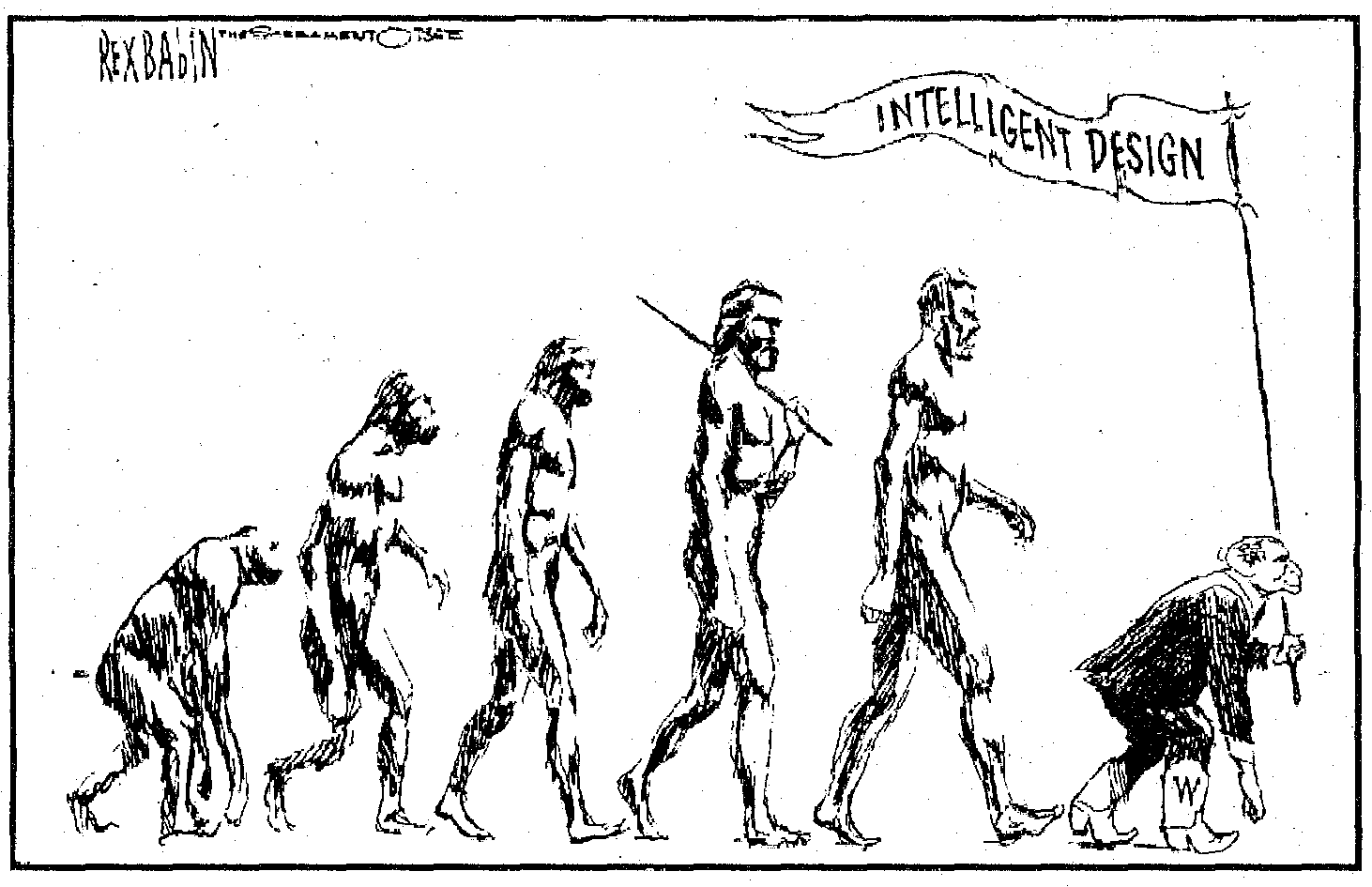
Intelligent?

Picture credit: the-messiahs-blog.blogspot.com

"We consider ourselves intelligent only because we are ignorant enough to overlook our foolishness."

Sep 13, 2012

Folly to be wise.

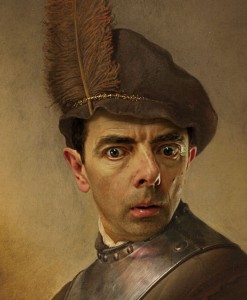
Rowan Atkinson as Mr.Bean: Wise or Unwise!

     "Sorrow is knowledge, those that know the most must mourn the deepest, the tree of knowledge is not the tree of life." - Lord Byron 

 
       We are overloaded with information from all sides. Every now and then, there is a dosage of information awaiting to be consumed by us. We are extremely privileged if we have the freedom to choose between consuming it or simply denying it. Because, as I see it, not all information is knowledge, and not all knowledge is wisdom. Above all, its not wisdom alone that drives our lives.
         Living in what is dubbed as the 'information era', I have due respect to the power of information and knowledge. I have been witness to incidents where the phrase 'knowledge is power' has lived up to its literary description and even beyond. But sometimes I do wonder how much of knowledge is sufficient power and does the excess of knowledge lead to disastrous consequences as does the excess of power?
       Though I doubt the absolute validity of Ernest Hemingway's statement "Happiness in intelligent people is the rarest thing I know", the statement is not without its share of truth! Knowing much of a thing/event/person, beyond what is necessary neither adds to knowledge, nor serves any purpose. Or does it? I do not have a generalized answer yet and doubt if I will ever have one because its more of a circumstantial question. But I doubt if Obsessive Attention to Detail (OAD), which is advocated by few new age Gurus as an ingredient to the so called success, is really worth all that attention! Maybe in realms where it pays off to know, it is worth to know and in other arenas, it is simply best to shut up and enjoy the show!
          If you are an Engineer, and the more of the technicality you master, the better is the product you design. Now that is a case where 'you take care of the small things and the big things will take care of themselves.' But if you are married and you decide to dig into every detail of your spouse, then is it not a sure recipe for disaster? The small thing to take care here is not to interfere into their sphere of autonomy and not to dig deep because 'the devil is in the details'!
        The happiest of all are children. (These days, peer pressure and hyper competition seem to be screwing up their happiness too.) And why are they so happy? Because they do not need a reason to be happy. Its their innocence that leaves them lot happier than most of us can ever be. They dig either into the earth or into the walls but not into the details!
        Most acts, however kind and altruist, when dissected to the finer details and analyzed critically may reveal some gray shades. Rather than looking at the darker side of things, it is up to us to choose to appreciate the beauty of the brighter side. Is it such a huge crime to have few gray shades, after all we are all mortals and it is our love for our own selves that characterizes us!
       It is not that I advocate ignorance. I do not think any issue has a single, one-dimensional solution, unless within the covers of a text book! The solution of every issue has to be pursued on a case by case basis, considering its circumstantial and consequential factors. So, there is no legitimacy in claiming ignorance to be a pragmatic solution. But I find myself agreeing with Thomas Gray, who penned these lines -
Yet ah! why should they know their fate? 
Since sorrow never comes too late, 
And happiness too swiftly flies. 
Thought would destroy their paradise. 
No more; where ignorance is bliss, 
'Tis folly to be wise.
           Life is simply all about walking on the Razor's edge. We place our feet too hard, the razor pierces our feet and we bleed. We walk too lightly, we loose balance and fall. The only way to walk on it unharmed is to place our feet as hard and as soft as is required! Maybe there in lies the detailed secret!!

Aug 14, 2012

The enigma called 'women'

Picture credit: broadrecognition.com

Men themselves have wondered
What they see in me.
They try so much
But they can't touch
My inner mystery.
                         - Maya Angelou 
                         ('Phenomenal Women')

            Oh women*, the greatest enigma ever to have existed, will we men ever be able to understand a billionth of you? Or will it always be that you are from Venus and we from Mars!? What creatures are you? What is it that fills your heart? How many emotions, how many feelings have you buried in there? Each dimple and each wrinkle on your face, do they hide beneath them epic stories in grace? Has ever a man deciphered at least one among the million thoughts masked in every gaze and stare of yours?
         How come is nature so unfair? You women are made so calm, composed and complex all at a time while we men can't even claim the credit to be at least one at a time! Is this inherent unfairness because nature too like you all is a graceful lady who prefers to shoulder her emotional traumas all by herself? Is it that you women are not wired the way we men are? We men are poor in looking at what is invisible, understanding what is not told and reacting to what is yet to happen. To us, what is white is white and what is black is black. But to you, like those intelligent physicists who widened the horizons of our knowledge, white is made of seven colors! Oh wait, only seven? I am talking of 'women' and they are blessed with the ability of such enormous multiplicity of thoughts, that maybe even seven billion or trillion thoughts might get triggered in them by a single word of ours.
         No, I don't complain of incompatibility. After all you are nature's most prized creation! All that I intend to say is that I am simply amazed by the ability that women possess. Any supercomputer, however technically superior, shall fare poor if it had to compete with the thought processing ability of the female brain. What extraordinary parallel processing of thoughts. You are now here, now there and now everywhere. You handle this, that, even that and what not! To men a super hero is either a Superman, or a Spiderman or a Batman. But not to women, for each one of you is a combo of Superwoman, Spiderwoman and Batwoman!
       The simple presence of women in the lives of men, in whatever form- daughter, sister, friend, colleague, wife, girl friend, guide, teacher or above all mother - makes our life come alive. (I have not had the privilege of the company of women in all these forms, but only a few. And a friend of mine remarks that is precisely the reason I am more appreciative of them.) You have the best shoulders to cry on; you are the best shock absorbers in times of crisis; you have that magical 1000 Watt smile that lights us up on any gloomy day and that genuine gentleness coupled with child like innocence which eases the process of living and makes life simply beautiful!
         But why is it that most of the times, you mean different from what you say? Given the foolishness of men like us, how come do you expect us to read between the lines? If it was Shakespeare, Voltaire or Dostoevsky we could have managed for they were all men, but you are women. Those high energy thesis of the Higgs Boson experiment seem understandable because they are told the way they are. Oh, how I wish there was a compiler which decoded your words into your thoughts. If technology ever manages to come up with such a decoder, that will be its greatest contribution in easing the life of men! You share events and expect us to react to your emotions which arose as a consequence to those events. Who on earth gave you the false impression that men are damn smart? I doubt if God himself is so smart!
         When it hurts, do let us know it hurts. When you are happy, please reveal it to us. We are dumb enough to pick up the wrong vibes, insensitive enough to fail noticing changes (which always turn out to be significant to you, when we fail to gauge its - forget the significance - presence itself) So, you tell us and we shall know it. Not that we shall always be the same dumb fools, but you help us increase our sensitivity. And one fine day, maybe we too will reach that peak of minimum maturity where reading between your lines becomes a possibility. If possible, please be a bit more insensitive. When we men say a thing, we usually mean only what we say. Please do not derive interpretations which never actually existed.
       But maybe it is all easy said than done. Is it? And we men may find it too hard to understand why it is so tough for you to put your thoughts into words. Well, if this is the way it is, then let it be so. Sometimes a status quo is the only thing which is the way to progress, because that is the only way of survival. We expect when things seem to be in our sway and accept when we realize we are in the sway of things. What better can we mortals do? The battle of the sexes has no end, for its end only signifies the arrival of the doomsday.
     Yet, we owe to you much much than you ever owe to us. What if Shakespeare said, 'Fraility, thy name is woman!' The universe itself is frail, isn't it? I have sincerely come to believe that the best in the business deserve every word of exaggeration in appreciation. And as I see it, certain women are more than the best when it comes to living a complete life! So, the appreciation of women in case is exaggerated, is still justified! I step away and would prefer to take a bow to you, the unbelievable species, with whom we men coexist. Not just coexist, but on whom we depend much more than you do on us. Women, without you, life would not be what it is. Nay, wrong again. Women, without you, how on earth would life be!

* Obviously not all women are alike, especially not the way described in this post. A lot of women might themselves disagree with this. But there are adorable women made of this stuff of legends, living epic lives. And they are the enigma that elude me!

Apr 11, 2012

A lot of difference.


“Sar Zamin-e-hind par aqwaam-e-alam ke firaq
kafile guzarte gae Hindustan banta gaya”
(“In the land of Hind, the Caravans of the people of
the world kept coming in and India kept getting formed”)
- Firaq Gorakhpuri  
    

       Despite the tremendous strides we have achieved as a nation and society, the ill feelings between ourselves owing to our religious differences have not totally  vanished. They sometimes appear to be consciously watered. Hatred being fed into young minds on various pretexts. The growing religious extremism haunts us mainly at two levels, as I perceive it. One, at the mass level - leading to various communal clashes. Two, at the intellectual level - leading to gross misconceptions about our religions and the true ideals they preach. 
         Though we claim to be highly educated, a large chunk of the educated class is yet to shun of its preoccupations on religious misconceptions. The never ending suspicion about the guy who wears an orthodox dress, lack of respect to a teacher whose accent supposedly reveals his religion, the foolish assumption that bearded guys are either of a particular religion or are a depressed lot. (God! How frequent a victim I have been to this assumption, all thanks to the beard I sport, well complemented by a supposedly dumb face!) Why, why these baseless set of reasoning? Why these shameless set of attitudes? Why this kolaveri di?
        As I shuffled through the pages of The Hindu (Apr 10, 2012), a newspaper which has become much more than a part of my life, I came across this very interesting letter from a reader. The letter is the precise piece which triggered this blog post.(I have taken the liberty to publish the letter on this blog, copying as it is from the official website of The Hindu here: http://www.thehindu.com/opinion/letters/article3297788.ece).

Brilliant

      In his brilliant article “A Sufi message from a Pakistani President” in the OpEd page of The Hindu (April 9), Saeed Naqvi mentions that Hasrat Mohani “… fancied that God had sent prophets to every country and the one he sent to India was Lord Krishna!” Nawab Akbar Yar Jung was a Judge of the Hyderabad High Court in the Nizam's Government. On August 11,1936, he addressed a meeting on the occasion of the Krishna Janmashtami in which he quoted the Holy Quran, 49:78, “We sent Apostles before Thee: there are some of them that We have mentioned to thee and others we have not mentioned.”
     “The Hindus; they accept Ramachandra and Shri Krishna as their religious leaders. We must therefore unhesitatingly accept them as prophets. I belong to a much hated sect of people who already hold this view. I do not hesitate to accept Shri Krishna (upon him be peace) as a prophet.”
      That reads as Krishna Alehsalam — a honorific not lightly used; Jesus is — Isa Alehsalam. There was a protest in Hyderabad against this speech and the Nizam reprimanded Bahadur Yar Jung. But no adverse action followed. That shows the catholicity of that government, chiefly due then to Sir Akbar Hydari, a Bohra.
       I think Nawab Akbar Yar Jung was an Ahmediya. He was the father of my dear friend and classmate Prof. Rasheedudeen Khan. When as a teenager, I spent my holidays with them, Nawab Sahib used to say to me, “Mian, Main Krishna Janmbhoomi ka hoon. Yeh log nahin samjenge!” Rasheed's mother was a Hyderabadi! Sir Mohammed Iqbal called Rama, Imam-i-Hind. Nawab sahib was calling Krishna a prophet, alehsalam. For those who understand these niceties, there is a lot of difference.
B.P.R. Vithal,
Hyderabad

        How beautiful! People of tolerance and acceptance are those who add to the faith and hope that one day all of us shall no more derive our identity based on the religions into which we were born but we shall take pride of the truly secular society in which we live. Everyday all around us are such souls of compassion and humanism. The ordinary men and women we encounter everyday and who make our every moment's peaceful co-existence a reality are actually extraordinary. Despite the lot of difference in their beliefs and culture it is the strength of this diversity that has kept the subcontinent alive and colourful. A responsibility each of us has to shoulder is to better it.
          Not long back, during the days of the controversy regarding the inclusion of A K Ramanujan's essay of 'Three hundred Ramayanas' in Delhi University course, I read an interesting anecdote in a magazine. An ex-judge of the Tamil Nadu High court, I don't remember his name exactly, probably Justice Hidayatullah was during his time considered the foremost authority on the Tamil epic Kamba Ramayana. Interests and curiosities know no barrier of religion and geographic boundaries, then why enforce them on the beautiful lives of posterity?
         As I read through the letter, I was reminded of these immortal lines, penned by the inimitable Sahir Ludhianvi -
तू हिन्दू बनेगा ना मुसलमान बनेगा
इंसान की औलाद है, इंसान बनेगा ।
....
नफरत जो सिखाये, वो धरम तेरा नहीं है।
इन्साफ जो रोंदे, वो कदम तेरा नहीं हैं।
कुर'आन ना हो जिसमे वो मंदिर नहीं तेरा,
गीता ना हो जिसमे वो हरम तेरा नहीं है ।
तू अमन का और सुलह का अरमान बनेगा।
इंसान की औलाद है, इंसान बनेगा ।
....
(Neither a Hindu nor a Muslim shall you become.
A human progeny are you. A human shall you become
......
Which preaches hatred, that religion is not yours.
Which tramples justice, that footstep is not yours.
Where is no Qur'aan, that temple is not yours.
Where is no Geeta, that Mosque is not yours.
An apostle of peace and harmony shall you become.
A human progeny are you. A human shall you become
......)

        The letter also took me down the memory lane. As a middle school kid, I was lucky to be taught Hindi and History(Social Science actually) by two Muslim teachers. I still remember how balanced the History sir would handle the subject of Muslim invasion into India and the growth of Hindu kingdoms down South. Though the delicacy of the issue was beyond my perception back then, I marvel at the ability of such teachers who assure objectivity and avoid flawed extremism from being sowed into tender minds. Both of them loved to play Cricket and we children got to play with them a few afternoons during the recess. Though I frequently dropped catches, I picked up the beauty of Urdu as a language. I do owe my present craze for Ghalib's poetry to those gentlemen.
        A few months ago, an elderly Muslim friend invited me to his new textile shop inauguration ceremony. Though I prefer to avoid ceremonial events, I chose to attend this one. He was indeed a very long acquaintance and there was no dearth of feel good moments despite decades of age difference between us. Unaccustomed with their tradition, I went to the venue well in time for the occasion. I wore a shirt and trouser unlike everyone else who were dressed in ceremonial kurtas, with the white topi adorning their heads. It was apparent that I had walked in too early and was obviously the odd one out. Minutes later the auspicious rendering of prayer was supposed to begin. It was a very small shop, hardly accommodating fifteen of us. The Maulvi looked at the owner, my friend and maybe his eyes questioned my presence. As I stood up to walk out, the gentleman - my friend held me and asked me to sit by his side in the very forefront. He told the Maulvi - "Apna hi ladka hai". The next fifteen minutes I sat through a blissful rendition of prayer, much of which I did not understand, but did get the feel of 'ameen'. 
         Yes, for those who understand these niceties, there is a lot of difference.

Mar 10, 2012

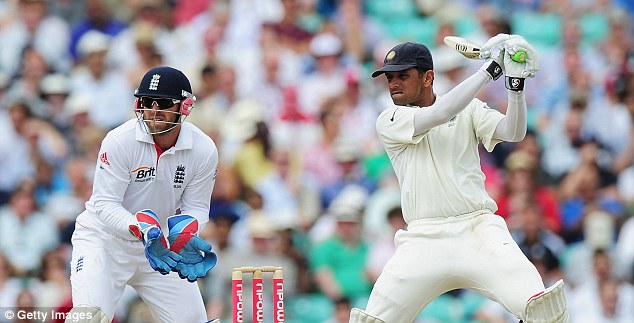
The white among the blues!!

        
"... gladiatorial intensity and monkish one pointedness of purpose; .. glint in the eyes, the eyes of a born warrior marooned in the belly of the Sahara desert with less than a day's ration left...."
                                                       - Nirmal Shekar, talking of Rahul Dravid.

       As middle school kids in the late 90s, only two things in cricket made sense to us. The runs scored by Sachin and the deliveries 'consumed' by Dravid. We, most of the times, cursed the later for 'wasting' deliveries. (He does hold the world record for facing highest number of deliveries in Test cricket - a whooping 31258!) ODIs, back then to us, meant nothing more than a full furnished version of the 'hit the ball with the bat' game we played on the streets, in the classrooms and into the kitchen!
      Only as age grew, the charm of test cricket got revealed. Then did I realize, however nail bitting a thriller was, the beauty of romancing poetry would be the most pleasing of all reading exercises. Then did the craze for men in blue die down and was born the benign bliss of watching the monk in white mediatate through innings of mammoth duration with almost absolute resoluteness. The calmness and dignity, the steadfastness and selflessness - Sometimes, I wonder if Dravid was that philosopher who preached only by practicing.
       For most in our generation, born after the Gavaskar and Kapil Dev era into the Tendulkar regime, Indian test cricket and Rahul Dravid are synonymous. Even people who never understood a speck of Test cricket would watch a few overs when the Dravid in white held fort. To be bathed in the radiance of his patient approach were moments to be cherished for.
      If as in football, a list of best defenders would be made in Cricket, not many would deny Dravid a rank at the helm. It was not for no reason that he was called 'The Wall' or 'Mr.Reliable'. He was that breed of batsmen who put the highest price on their wicket. No bowler was ever given his wicket, the bowler had to toil to take it. Years ago, rushing out of an exam hall, I called a friend to ask him the score. He told - "Pray God to save wickets at one end." Any guy could have understood Dravid stood at the other end.
      A second fiddle like no other, Dravid has been part of some extraordinary partnerships in cricketing history. Many fine innings of Tendulkar, Ganguly and Laxman were carved out in Dravid's company. He stood along when they stood, he stood alone when none stood. In a game of uncertainties, Dravid was for long the certain guardian. Though a specialist No.3, he did open the innings when the team needed him to or came in late at No.6, when that was asked of him. How forget the days when he kept wickets in a bid to stabilize the team's make up.
       While men of muscle skied the ball across the boundary, Dravid was more of an artist who worked for the singles and twos as if engineering his way to pursue them. Despite the storms, downpours or scorching heat - the likes of Waqar Younis, Glenn McGrath or Allan Doland - Dravid would water the seeds of an innings unperturbed and see through every stage of its growth, fighting with the grit of a never-die spirited farmer who gave all his to ensure the plant flowered and bear fruits. However high the stakes or however immense the pressure mounted, never a sign of rage. If Indian cricket is an orchestra troop, whose soothing music we have enjoyed, then the invisible conductor whose face has seldom hogged the limelight is Rahul Dravid. Always calm, composed and beyond doubt the man for all seasons, either on field or off field.
       As I close my eyes and think of Dravid, to my mind always comes a picture. On a field among men in blue I see him in white. He is all set to face the delivery. Shifts body weight to the back foot, waits for the ball and plays his characteristic late cut so late that it appears as if he just pushed the ball out of the keeper's gloves. Before I can completely grasp the beauty of it, he is out of his crease and running.... This time, not to come back again...

Feb 29, 2012

Revisiting 221B, Baker Street!!


'Omne ignotum pro magnifico' 
(The unknown is always thought to be magnificent)
     This is my favorite phrase from Latin. A very true one. As long as we do not get to know someone from very close quarters, we look at them in awe. But on getting close and discovering their mortality and imperfections, the awe dies down. But, I am witness to an exception - the most extraordinary exception. The character, who introduced the phrase to me more than a decade ago still appears as magnificent as he did on that fateful day or probably even more! What an irony to call him an exception who always rejected them - "I never make exceptions. An exception disproves the rule." Yes, the magnificent one is none other than Mr.Sherlock Holmes!! 
      Tough to capture the essence of Sherlock in words. Or is he just beyond description? The best I have come across yet is his own! As he states in 'The Sign of Four': "There are in me the makings of a very fine loafer and also of a pretty spry sort of fellow. I often think of those lines of old Goethe - Schade dass die Natur nur Einen Mensch aus Dir schuf, Denn zum wuerdigen Mann war und zum Schelmen der Stoff. (Nature, alas, made only one being out of you, Although there was material for a good man and a rogue.)"
      Given his character, he could have gone on to be the best philosopher or scientist in the world of fictional literature. But, he was Sherlock and he had his own way of doing things - a way no one else could even think of!! "My mind, rebels at stagnation. Give me problems, give me work, give me the most abstruse cryptogram or the most intricate analysis, and I am in my own proper atmosphere. I can dispense then with artificial stimulants. But I abhor the dull routine of existence. I crave for mental exaltation. That is why I have chosen my own particular profession, or rather created it, for I am the only one in the world." The world's first and beyond doubt the best consulting detective! “The only unofficial consulting detective. I am the last and highest court of appeal in detection." One whose singular ability to deduce truth has never had any near competition in the universe.
       Holmes, the master of the Science of deduction, is not just a fictional character brought to life by the imaginative genius of Sir Arthur Canon Doyle; but is that charisma and enigma which has shaped the way detective fiction, criminology, forensic science, human psychology, the science of cognition, the philosophy of logic and reasoning have evolved over generations. He is of that rarest breed of characters who elevated criminal investigation to a fine art and a science demanding subtle observation and intelligent research. The impact of the over 150 year old character (his first appearance was in 1857) on the field is so profound that in 2002, the Royal Society of Chemistry bestowed an honorary fellowship of their organisation upon Holmes, for his use of forensic science and analytical chemistry, making him the only fictional character to be thus honoured! His influence on serious academic research is also noteworthy. Google scholar shows up the mention of Holmes in highly regarded research papers in fields as diverse as expert psychology, analytical chemistry and medical jurisprudence among many others.
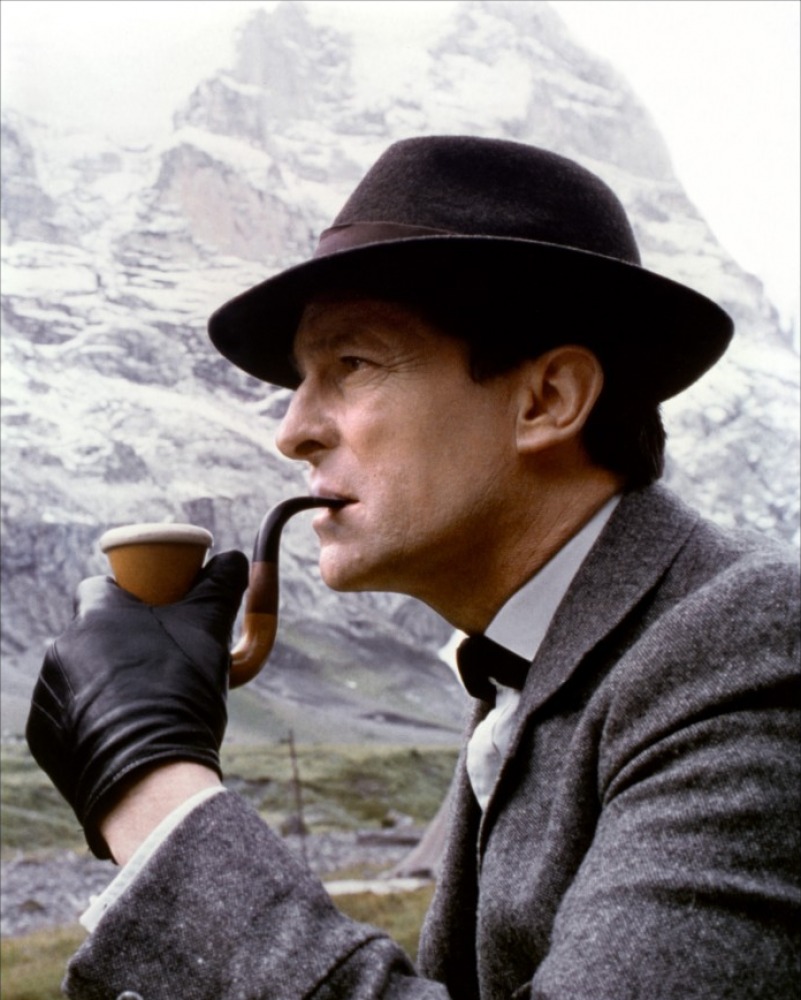
        He is also one of the finest intelligent entertainers - a hot favorite on stage and on screen as well. The Guinness World Records has consistently listed Sherlock Holmes as the "most portrayed movie character" with more than 75 actors playing the part in well over 200 screen adaptations and the list is still growing strong! (If you never watched 'Jeremy Brett' play Holmes to perfection, curse yourself for not yet catching up the performance of the bygone century! Also Benedict Cumberbatch does make a sound impression in the BBC's fine recreation of 'Sherlock'.)
Jeremy Brett as Sherlock on screen.
         The chemistry between Holmes, the character and Doyle, his creator is one which has no parallels in the realm of literature. Theirs was probably a duel like no other. Maybe Holmes out lived Doyle in all the ways. Doyle did almost kill Holmes in the 'Final problem', may be he was desperate to - "even if I buried my bank account with him," he wrote in his autobiography. He was relieved during the 'Great Hiatus', as is evident from his statement - "I have been much blamed for doing that gentleman to death, but I hold that it was not murder, but justifiable homicide in self-defense, since, if I had not killed him, he would certainly have killed me." But Holmes worked his way out! Doyle had to relent to the mounting pressure from publishers and public alike, Holmes reappeared in the 'Adventure of the empty house' outwitting death too! Despite the enormous success and following Doyle enjoyed, courtesy Holmes, he actually complained in his later years - "If I had never touched Holmes, who has tended to obscure my higher work, my position in literature would at the present moment be a more commanding one."
      We talk of Holmes and we don't talk of Watson, we are not talking of Holmes! Or, as Holmes himself rightly pointed out, “Where would I be without my Boswell?” One of the finest friendships, with its unique intricacies. I don't think it an exaggeration to say, any guy shall feel jealous of Holmes for having a companion as good as Dr.Watson! "Come at once if convenient — if inconvenient come all the same" is how Holmes sends for Watson! Though very cold blooded and never a man for sentiment, Holmes has a very special regard for Watson, which is seldom revealed. Except in an adventure where Watson gets hurt and recalls it as a worthy wound, "it was worth many wounds - to know the depth and loyalty of love which lay behind the cold mask. The clear hard eyes were dimmed for a moment, and the firm lips were shaking. For the one and only time I caught a glimpse of a great heart as well as a great brain."
       Despite Watson's claims that Holmes' "ignorance was as remarkable as his knowledge", Holmes does at times appear to be a polymath. He quotes from Goethe, remembers details of little known historical facts, his knowledge in Chemistry is simply amazing and the geography of London is a child's play to him! Maybe he knew too well that to master the important, the biggest prerequisite was to recognize and leave behind the unimportant. 
     Why does his character stand out for more than a century and a half, that too in times of such immense changes? Because there was none like him before and there can none ever be like him, except him. As straight forward as it gets - "I cannot agree with those who rank modesty among their virtues. To the logician all things should be seen exactly as they are, and to underestimate one's self is as much a departure from the truth as to exaggerate one's powers." Absolutely logical, unflawed reasoning - "It is an old maxim of mine that when you have excluded the impossible, whatever remains, however improbable, must be the truth." Undying yearning to learn - "Education never ends Watson. It is a series of lessons with the greatest for the last." Much beyond us, but still like us - "It was easier to know it than to explain why I know it." The most vigilant eyes, tailor made for detail - "You see, but you do not observe. The distinction is clear." Subtle and subtle to the core - "It is, of course, a trifle, but there is nothing so important as trifles."
      Holmes is one of variety. Each Holmesian has his own reason to adore the Master. Despite the differences, he is never less than an obsession to each one. What work and cocaine were to Holmes, that is Holmes to us. For me, what absolutely stands out in the master sleuth is his philosophy towards life. There is no dearth of philosophical insights in his monologues and punch lines - "Everything in this world is relative, my dear Watson."; "When one tries to rise above Nature one is liable to fall below it."; "Life is infinitely stranger than anything which the mind of man could invent." He can go on and on like this for a very long time. Credit, recognition, fame were never among his incentives. To him work and work alone was the source of all pleasure in life. Cocaine served as a feeble substitute in the absence of challenging work. "The work is its own reward." - the line by which he lived and almost died! His clarity in this approach never witnessed a change. It was always - "I prefer to work anonymously, and it is the problem itself which attracts me." Never could the temptation of jumping to conclusions beat him - "It is a capital mistake to theorize before you have all the evidence. It biases the judgment." A fair acceptance of he too being a mortal like us despite his far reaching abilities - "Slips are common to all mortals, and the greatest is he who can recognise and repair them." 
       Never the one to get carried away by emotions, Holmes does respect the emotions of others. "I have never loved, Watson, but if I did and if the woman I loved had met such an end, I might act even as our lawless lion-hunter has done. Who knows?" Though in a handful of cases he lets go of the one who commits a crime when the circumstances make the crime justifiable, he is not the one to expressly voice his opinions on their acts. "It was my duty to bring the facts to light, and there I must leave it. As to the morality or decency of your conduct, it is not for me to express an opinion." 
         Holmes does seem arrogant. He is at times a bit over confident, but what difference does exist there when you are dead sure of it?
"I followed you."
"I saw no one."
"That is what you may expect to see when I follow you."

       I too like Watson "had no idea that such individuals exist outside of stories." But I think I may be wrong because I don't see anyone and how I wish I am being followed!!

Dec 10, 2011

Nothing left to give?


"If we don't change direction soon, we'll end up where we're going."
- Prof. Irwin Corey

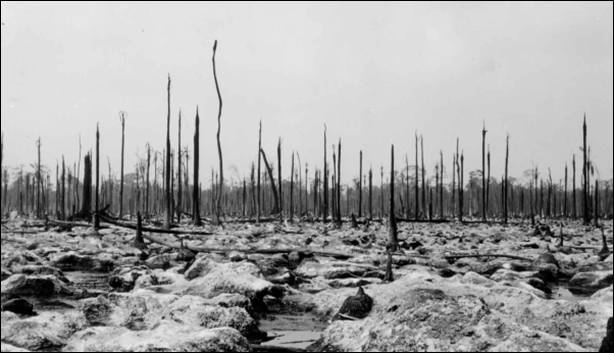
      During my college days, I had a chat concerning 'the ethics of innovations' with a Professor. He opined, it is not a good thing to keep track of sustainability or consequential effects of an innovation while in the process of its incubation. The appropriate way to proceed with innovations and ideas is to look at the positive side of things rather than at the limitations they could possibly impose later. So an Engineer need not burden himself with the other consequences once his objective is achieved, it is an option left to his discretion. We had a healthy debate on his stand but I ended up failing to convince myself of what I actually thought about it. It still haunts me if its totally fine not to be burdened by the additional responsibility of its effects on nature? All innovations are not separate entities, but part of the gigantic system of nature. Then does the requirement of ensuring its compatibility with nature lie with the innovator? I fail to arrive at an answer to these questions.
      The reason I was reminded of this is a recent discussion I had with a friend of mine. He put forth the two arguments usually encountered in topics of man and his encroachments into nature. One school of thought is that man is damaging nature to irreparable extents. The other, nature has its unique ability to reinvent itself despite the pressure it is put through. Discussing on the topic, we both concurred it is most likely that nature reinvents itself but at the cost of humanity. When nature does reinvent itself to sustain its existence, what might be left of us are 'Humanoids' - "those who cease to live and start to exist."
       Before I could come out from the mood of the chat, I came across this dialogue from the film Apocalypto:

And a Man sat alone, drenched deep in sadness.
And all the animals drew near to him and said: "We do not like to see you so sad…Ask us for whatever you wish and you shall have it."

The Man said, "I want to have good sight."
         The vulture replied, "You shall have mine."

The Man said, "I want to be strong."
        The jaguar said, "You shall be strong like me."

The Man said, "I long to know the secrets of the earth."
        The serpent replied, "I will show them to you."
And so it went with all the animals.
And when the Man had all the gifts they could give, he left..

       Then the owl said to the other animals, "Now the Man knows much and is able to do many things. Suddenly I am afraid."
       The deer said, "The Man has all that he needs. Now his sadness will stop."

       But the owl replied, "No. I saw a hole in the Man deep like a hunger he will never fill. It is what makes him sad and what makes him want. He will go on taking and taking. Until one day the world will say: ‘I am no more and I have nothing left to give.’"


        I still don't have any concrete answer to those questions of mine. But I pray I shall not have to wait for my answers till nature has nothing left to give.

Nov 25, 2011

ಬೇಸಾಯ: ನೀ ಸಾಯ?


"ಯಾರೂ ಅರಿಯದ ನೇಗಿಲ ಯೋಗಿಯೆ ಲೋಕಕೆ ಅನ್ನವನೀಯುವನೋ
  ಹೆಸರನು ಬಯಸದೆ, ಅತಿ ಸುಖಕೆಳಸದೆ, ದುಡಿವನು ಗೌರವಕಾಶಿಸದೆ.
  ನೇಗಿಲ ಕುಲದೊಳಡಗಿದೆ ಕರ್ಮ, ನೇಗಿಲ ಮೇಲೆಯೇ ನಿಂತಿದೆ ಧರ್ಮ."
                                                           - ಕುವೆಂಪು 


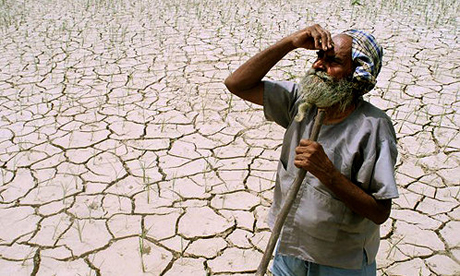
         ವ್ಯವಸಾಯದ ಕುರಿತಾಗಿ ಹತ್ತು ಹಲವು ಆಲೋಚನೆಗಳು ತಲೆ ಹೊಕ್ಕಿ ಕುಳಿತಿದ್ದವು. ಪಿ.ಸಾಯಿನಾಥರವರ 'Everybody loves a good drought' ಪುಸ್ತಕ ಹಾಗು "Nero's Guests" ಸಾಕ್ಷ್ಯಚಿತ್ರ ಇಂದಿನ ಜಾಗತಿಕ ಮಾರುಕಟ್ಟೆ ಮತ್ತು ರಾಜಕೀಯ ವ್ಯವಸ್ಥೆ ಕೃಷಿಯನ್ನು ಎಲ್ಲಿಗೆ ತಂದು ನಿಲ್ಲಿಸಿವೆ ಎಂಬ ಹಸಿ ಸತ್ಯಗಳನ್ನು ಸೂಕ್ಷ್ಮವಾಗಿ ಕಟ್ಟಿ ಕೊಡುತ್ತವೆ ಎಂಬ ನನ್ನ ಅಬಿಪ್ರಾಯವನ್ನು ಗೆಳೆಯನೋರ್ವ ಅಲ್ಲಗಳೆದು ಇವು ತೀರ ಏಕಪಕ್ಷೀಯ ವಾದಗಳೆಂದು ತನ್ನ ಅಬಿಪ್ರಾಯ ಹಂಚಿಕೊಂಡ.  ಹೀಗೆ ಹೊರಟ ನಮ್ಮ ವಿತ್ತಂಡವಾದವನ್ನು  ಕೊನೆಗೊಳಿಸಿದ್ದು 'ಕೆ ವಿ ಅಕ್ಷರ'ರವರ "ವ್ಯವಸಾಯದ ಅವಸಾನ" ಎಂಬ ಲೇಖನ. ಅದರ ಕೊನೆಯ ಕೆಲವು ಸಾಲುಗಳನ್ನು ಓದಿ ನಾವಿಬ್ಬರು ನಿರುತ್ತರರಾದೆವು. ಆ ಸಾಲುಗಳನ್ನು ಇಲ್ಲಿ ಉಲ್ಲೇಖಿಸಿದ್ದೇನೆ - 
  
        ವ್ಯವಸಾಯದ ಅವಸಾನ ಕುರಿತು ನನ್ನ ಚಿಂತಾಲಹರಿಯನ್ನು ಕೆಲವು ದಿನಗಳ ಹಿಂದೆ ನಮ್ಮೂರಿನ ಕೃಷಿಕರೊಬ್ಬರ ಮುಂದೆ ಬಿಚ್ಚಿದೆ. ತುಂಬಾ ಅನುರಕ್ತಿಯಿಂದ ಕೃಷಿ ಕೆಲಸಗಳನ್ನು ಮಾಡುವ ಅವರು ಒಂದೇ ಮಾತಿನಲ್ಲಿ ನನ್ನ ತೀರ್ಮಾನಗಳನೆಲ್ಲಾ ಬುಡಮೇಲು ಮಾಡಿದರು - 'ನಿನ್ನ ವಾದದಲ್ಲೇ ಒಂದು ತೊಂದರೆಯಿದೆ. ಎಲ್ಲ ಸಮಸ್ಯೆಗಳಿಗೂ ಸರ್ಕಾರವೋ ಅಥವಾ ವ್ಯವಸ್ಥೆಯೂ ಕಾರಣವೆಂದು ನೀನು ತಿಳಿದಿದ್ದಿಯ. ಆದರೆ ಸಮಸ್ಯೆ ಇರುವುದು  ಪ್ರತಿಯೊಬ್ಬ ಕೃಷಿಕನ ಮನಸ್ಸಿನಲ್ಲೇ ಹೊರತು ಕೃಷಿಯಲಲ್ಲ . ಕೇವಲ ಲಾಭಕ್ಕಾಗಿ ನಾನು ಕೃಷಿ ಮಾಡುವುದಿಲ್ಲ, ಅದು ನನ್ನ ಬದುಕು ಎಂದು ಯಾರಾದರೊಬ್ಬ ಕೃಷಿಕ ನಿಜವಾಗಿಯೂ ತಿಳಿದಿದ್ದರೆ, ಅಂಥವನು ತನ್ನ ಕೃಷಿ ವಿಧಾನವನ್ನಾದರೂ ಬದಲಾಯಿಸಿಕೊಂಡು ಈ ಸಮಸ್ಯೆಗಳನ್ನು ಪರಿಹರಿಸಿಕೊಳ್ಳುತ್ತಾನೆ. ಆದರೆ, ಇವತ್ತಿನ ಕಾಲದ ವ್ಯಾಪಾರ ವಹಿವಾಟಿನಂತೆಯೀ  ಕೃಷಿಯು  ರಾಶಿ ರಾಶಿ ಹಣ ತರಬೇಕು ಎಂದು ಭಾವಿಸುವ 'ಮಾನಸಿಕ ಅನಿವಾಸಿ'ಗಳಿಗೆ ಮಾತ್ರ ಇದು ಪರಿಹರಿಸಲಾಗದ ಸಮಸ್ಯೆ!'
      'ಹಾಗಿದ್ದರೆ ಇವತ್ತಿನ ಕೃಷಿ ಬಿಕ್ಕಟ್ಟಿಗೆ ಉತ್ತರ ಕೃಷಿಕರಿಂದಲೇ ಬಂದೀತು ಎಂಬುದು ನಿಮ್ಮ ಊಹೆಯೇ?' - ನಾನು ಕೇಳಿದೆ.
      'ಅದು ಬರಿಯ ಊಹೆಯಲ್ಲ. ನನ್ನ ದೃಡವಾದ ನಂಬಿಕೆ.' - ಎಂದು ಅವರು ಮುಗುಳ್ನಕ್ಕರು.
                                                                                                                - ಕೆ ವಿ ಅಕ್ಷರ

        ಇದು ಮಧ್ಯಮ ಅಥವಾ ಮೇಲು ಧರ್ಜೆಯ ಕೃಷಿಕನಿಗೆ ಅನ್ವಯಿಸುತ್ತದೆ ಆದರೆ ಕೆಳಮಟ್ಟದ, ಸಣ್ಣ-ಪುಟ್ಟ ಕೃಷಿಕನಿಗೆ  (ಆರ್ಥಿಕ ಹಾಗು ವ್ಯವಹಾರಿಕ ಮಾನದಂಡಗಳಲ್ಲಿ) ರಾಶಿ ರಾಶಿ ಹಣ ತರಬೇಕು ಎಂಬ ಮಾನಸಿಕ ಅನಿವಾಸಿತನಕ್ಕಿಂತಲೂ ಮೊದಲು, ದಿನ ನಿತ್ಯದ ಜೀವನ ಸಾಗಬೇಕು ಎಂಬುದೇ ಮುಖ್ಯವಾಗುತ್ತದೆ. ಈ ದೃಷ್ಟಿಯಿಂದ "Nero's Guests" ಸಾಕ್ಷ್ಯಚಿತ್ರದಲ್ಲಿನ ಅಳಲು ಹಾಗು ಸಾತ್ವಿಕ ಆಕ್ರೋಶ ಏಕಪಕ್ಷೀಯವಾಗಿರದೆ ಸಮಂಜಸವೂ, ಪ್ರಜ್ಞಾಪೂರ್ವಕವಾಗಿಯೂ ಇದೆ ಎಂಬುದು ನನ್ನ ಅನಿಸಿಕೆ. ಆದರೂ ಅಕ್ಷರರವರ ಕೃಷಿಕ ಮಿತ್ರರ ನಂಬಿಕೆ ನಿಜವಾಗಲಿ ಎಂಬುದೇ ಕೋರಿಕೆ. ಕೃಷಿಯ ಎಲ್ಲಾ ಸ್ತರಗಳಿಗೂ ಅನ್ವಯವಾಗುವ ಉತ್ತರವೊಂದು ರೈತ ಬಂಧುವಿನಿಂದಲೇ ಮೂಡಲಿ. ಪ್ರಜಾತಂತ್ರದಲ್ಲೋ, ಮತ್ತೊಂದು ಹಸಿರು ಕ್ರಾಂತಿಯಲ್ಲೋ - ಇಲ್ಲೇ ಎಲ್ಲೋ ಅರಳಲಿ. ಮಹಾಪ್ರಳಯದವರೆಗೂ ಕಾದು ಕುಳಿಯುವ ನಮ್ಮ ವ್ಯವಧಾನ ಅಳಿಯಲಿ.

"Only the tillers of the soil live by the right. The rest form their train and eat only the bread of dependence."
                                                        - Thiruvalluvar

Sep 27, 2011

The dichotomy of Decision making.


"To be, or not to be: that is the question
Whether 'tis nobler in the mind to suffer
The sling and arrows of outrageous fortune,
Or to take arms against a sea of troubles
And by opposing end them.
                 - Shakespeare (in Hamlet)"

         In an unconscious way, choices we make today determine our decisions tomorrow. What we fail to realize at times is before we take a decision, its long been decided at the sub conscious level when our persual of the objective is intense and all pervasive. A lot of our perceptions and attitudes get aligned towards the decision we are headed to. Life just takes us to the point when that is the only choice preferred.
        Not always are we as lucky. Most of the times we fail to negotiate what is the objective we yearn to pursue. That is when the dichotomy of decision making presents itself to us in all its grandeur of confusion!! Its not easy to discover what is the purpose of a persual in the early stages. Sometimes, only when the pursuit is near completion do we exactly realize the purpose. Maybe thats the way of life.
    Decision making is like the problem of optimization theory. Any student of mathematical optimization might appreciate the beauty of the analogy. In any method of constrained optimization, its the technical constraints and sign restrictions that determine the feasibility and optimality of the solution in connection with the objective function. All issues of decision making boil down to this. The feasible solutions are found with considerable ease. But its the test of optimality that posses the biggest challenge. In arriving at a decision, though feasible options are presented after a few sessions of introspection and brain storming, its the challenge to pick the optimal one and tailor it to suit our needs that is a test of character. The time when decision making gets gritty and gruesome.
      Priorities have to be weighed. Relationships, Career advancements, Opportunities, Scope for pursual of interests - My god! the list of constraints to be adhered itself turns to be an overhead at times. Sometimes we may wish to break away from all the constraints and just fly free. But this overhead is what adds beauty to the process of decision making. Once an optimal solution is arrived at after due considerations to individual specific constraints, there is a relaxing satisfaction. (I agree, it does not stay long in our transient world;-). But still for the moment, a soothing relaxation does exist.)
       Too much of analysis spoils the beauty of anything and everything. The devil is in the details. Once we arrive at a decision, it is better we do not go back frequently to reasses its worth. Suggestions and advices, the most freely available drugs in the market, when do not take into account our position and percetions push us to the peak of pessimism. A lot of criticism is always in stock, for the cynics have nothing better to offer! Though constructive criticism is welcome, sometimes its the freedom to explore, falter, rediscover and learn that adds life to the process. All decisions ultimately help us learn and to learn is to live.
       The world is never seen identically by any two pairs of eyes. So its not alwas necessary that our decisions are agreed and appreciated by our fellow beings. Its our conviction to stand by the decision we take that defines the consequences of it. None of us are inherently perfect. All our decisions can be dynamic. We might realize its non feasibility and modify it to suit our needs but only owing to self realization would be better rather than owing to persual or pressure.
     When a good friend said - "the arrival at a decision limits the choice of freedom", I got into introspection only to infer that decisions are not always necessary. Maybe we tend to over decide;-) Though taken, they need not be all pervasive. Its true that when we pick one end of a stick we pick up the other end too. But do we take it for granted that we should never place the stick back?? If the stick is either too lengthy or heavy or not long enogh, I would prefer to place it back and try find a better one that suits me!!

Aug 21, 2011

A thankless job!?


"The mediocre teacher tells. 
The good teacher explains. 
The superior teacher demonstrates.
The great teacher inspires. 
                  -William Arthur Ward"


         Working as a part time lecturer is giving me newer perspectives about the thoughts in the emerging youths. A thoroughly enjoyable profession, as it has appeared to me over a year. Waiting to engage a class, last week, I was chatting with a Assistant Professor who suggested me to do something else since teaching, he felt, was a thankless job with no scope for achievement!!
          
        With all due respects to the gentlemen who think so, here is an excerpt from an article entitled "Good teaching qualities" authored by Premchand Palety:


Sharu S. Rangnekar, a leading management teacher and consultant, told me how his teacher induced in him an interest for Sanskrit:

In the first period he taught us, we were 40 boys ready to listen. The first sentence he said was, “Boys! You are lucky.”

We asked him in chorus, “Why?”

“Do you know what you are going to learn?” he asked.

“Sanskrit,” we replied.

“What is Sanskrit?” he asked.

Most of us replied, “A language.” One student said, “A scoring subject (in our time there were only three subjects in which one could score 90% or more: mathematics, science and Sanskrit).”

“You are all wrong,” he said. “Sanskrit is not just a language or a scoring subject. It is a key to 3,000 years of culture. With this one key the whole treasury is yours.”

Not everybody believed him—but 10-12 of us did. After matriculation, Sanskrit was of no use to me in chemical engineering or MBA—but I still read Sanskrit. It is a virus that cannot be removed.

When my Sanskrit teacher retired after 35 years of service, I visited him. He started as a Sanskrit teacher and ended as a Sanskrit teacher; did not become even a vice-principal!

“What did you achieve in your life?” I asked him.

“Sanskrit is becoming a dead language; but I got every year a batch of 40 students. I tried to infect them (with interest for Sanskrit)—I know I could not infect everybody, perhaps 10-12 in each batch. After these 35 years, there are 400 former students of mine who must be still reading Sanskrit—this is my achievement.”

   In the same write up, the author cites about a research and says:
       The research on the impact of expectations was done in the 1960s by Robert Rosenthal of Harvard University and Lenore Jacobson of South San Francisco Unified School District. They showed that when a teacher has positive expectations of a student, the student’s performance improves.

            When we teachers look at ourselves as being in an inferior profession, visualizing to have been dumped into this job because we could not pursue our dreams or were pressurized by life to feed ourselves, then we would be deliberately placing ourselves at the bottom of the table of social eminence. 

         Paying attention to a conversation between a post graduate student and a senior lecturer on career options, I ended up listening the student say she would prefer to stay unemployed rather than 'ending up' as a lecturer. To my then shocking disappointment and disbelief, the so called Senior lecturer encouraged this decision of hers!! (Incidents like these do not give me shocks anymore, as I am accustomed to their frequent occurrences.)

         The sorry state of affairs in the domain of education today is clearly a measure of the extent to which education has become a commodity to be sold and bought rather than a life lesson which has to be learnt and cultivated.

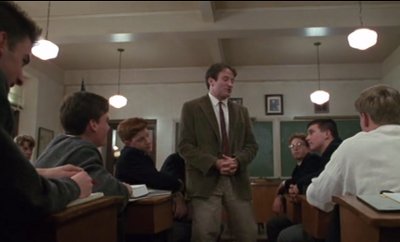
Robin Williams playing the character of John Keating in the movie "The Dead Poet's Society"
           Speaking to a friend on this issue, he asked me "Do teachers like Mr. John Keating(The Dead Poet's Society), Ms.Erin Gruwell(Freedom Writers) and Mr.E.R.Braithwaite(To Sir, With Love) exist only in stories and movies?" No, my dear friend, there are a lot of inspiring and extraordinary teachers around us. I take pride in being a student to a few of the great breed and believe all of us have had the privilege of learning from some great masters, at some point of time in our lives. To all those teachers of the great legacy who once existed, who are amidst us today and who shall be born in time -

brahmAnandaM paramasuKadaM kEvalaM j~JAnamUrtiM
dvandvAtItaM gaganasadRuSaM tatvamasyAdilakShyam |
EkaM nityaM vimalamacalaM sarvadhIsAkShiBUtaM
BAvAtItaM trigunarahitaM sadguruM taM namAmi ||

                                                                          - Guru Gita ( from Skanada Purana)


          I prostrate to that Sadguru who is Brahman that is bliss, who conferrs happiness, who is the incarnation of pure consciousness, who is unaffected by the pair of opposites, who is like the sky, who is the implied meaning of mahavakyas like tat tvam asi (thou art that); one and only, eternal, pure, immutable, the witness of all intellects, transcending existence, free from the three gunas(sattva, rajas and thamas.)

Aug 5, 2011

Neither are they wrong, nor are we!!


       There have been a few experiences over the past couple of weeks, when I got to witness the classic Parents vs Children debate. On one side were parents insisting their son to pursue higher education at the US, which the guy is least interested in. On the other side is another friend who is trying hard to convince her Dad to let her study out of her hometown!! (So sad, how nice it would have been if the cases were vice versa.. Crazy thought, I agree). These are just a couple of the interesting cases I have been an audience to. Both the sides have reasonable logics defending their arguments. Both seem justifiable in their own rights. Being a youngster, I tend to identify myself pitted against parents. Well a bit of introspection reveals neither are they wrong, nor are we!!

     As I wondered over this age old issue, there was an interesting aspect a friend of mine shared with me. In ancient India, it is said, when householders retired from Grihastha to Vanaprastha, they gave away all that they possessed. They left their children with education and experiences of life. The children were asked to shape up their lives from scratch. How contrasting from a lot of today's parents who try to amass all that they can in their lifetime so that their children live in peace. Despite the children not wanting them to do it! But of course, times have changed.

      Another interesting case is here - A friend of mine works as an Engineer at a place where his Dad has considerable acquaintances. The father whenever pays a visit to the son's workplace, addresses him in his pet name, which is embarrassing to the son. Seems silly? Not to the guy who faces it. Here is his argument - "I am his son. To him I may still be a kid. But not in the society we are part of." No offences meant, but this is a simple issue with complicated consequences!!

        As I spoke with Mom about issues like these, she reminded me of the Sanskrit verse -
लालयेत् पञ्च वर्षाणि दश वर्षाणि ताडयेत् | 
प्राप्ते तु षोडशे वर्षे पुत्रं मित्रवदाचरेत् ||
(Indulge a child for the first five years of his life, for the next ten years deal firmly with the child. Once the child is sixteen, treat him as a friend.)
       It is not an easy task of being friends. Sometimes we don't give parents enough space for the friendship to evolve and at times, they are not willing to extend a friendly gesture. But the tragedy of affairs is that usually when they are willing we are not and vice versa!!

         Talking to friends undergoing similar crisis, the most interesting argument I encountered is as follows - What do we youths look for in life that cause tribulations as these? The freedom to explore our paths. Maybe elders have already strode those paths and realize their shortcomings. But some of us are foolish and adamant and wish to discover the truth for ourselves. Such fools(though we tend to call ourselves 'explorers' or the 'makers of our own destiny') would expect to be left to themselves. Nothing teaches better than experience. We might err and falter. But we do not want to die with the guilt of not having tried. Elders with all their care and expertise in life would do good to help us recover from the fall, and keep us inspired for the next exploration;-)

         Maybe this is all necessary. These experiences to us may add up as lessons of life and somewhere down the lane, they may aid us in understanding these lines of Khalil Gibran -
Your children are not your children.
They are the sons and daughters of Life's longing for itself.
They come through you but not from you,
And though they are with you yet they belong not to you.
You may give them your love but not your thoughts, 
For they have their own thoughts.
You may house their bodies but not their souls,
For their souls dwell in the house of tomorrow, 
which you cannot visit, not even in your dreams.
You may strive to be like them, 
but seek not to make them like you.
For life goes not backward nor tarries with yesterday.

Jul 3, 2011

ಅಲೆಮಾರಿಯೊಂದಿಗಿನ ಅಲೆದಾಟ : ಭಾಗ -೧


          'ಕರ್ವಾಲೊ', ನನಗೆ ತೇಜಸ್ವಿಯವರನ್ನು ಪರಿಚಯಿಸಿದ ಕೃತಿ, ಸಾಹಿತ್ಯದ ಹುಚ್ಚು ಹಿಡಿಸಿದ ಕೃತಿ, ಹುಡುಕಾಟದ ಬಗ್ಗೆ ಹೇಳತೀರದ ಒಲವು ಬೆಳೆಸಿದ ಕೃತಿ. ಆ ಪರಿಚಯದಂದಿನಿಂದ ತೇಜಸ್ವಿಯವರ ಸಾಹಿತ್ಯ ನನಗೆ ಸಿಹಿ ಕಜ್ಜಾಯ. ಈ ಬ್ಲಾಗಿನ ಶೀರ್ಷಿಕೆಗೂ ಅವರ ಸಾಹಿತ್ಯದಲ್ಲಿನ ಹುಡುಕುವ ಪ್ರಕ್ರಿಯೆಯೇ ಸ್ಪೂರ್ತಿ ಎಂದರೆ ಅತಿಶಯೋಕ್ತಿ ಆಗಲಾರದು. ಸಾಹಿತಿ, ಕೃಷಿಕ,  ಛಾಯಾಗ್ರಾಹಕ, ಪ್ರಕೃತಿ ಪ್ರೇಮಿ, ಪಕ್ಷಿ ವೀಕ್ಷಕ - ಹೀಗೆ ಹಲವು ಸಾಮಾಜಿಕ ಸ್ಥರಗಳಲ್ಲಿ ಇದ್ದು ಇಲ್ಲದಹಾಗೆ, ಸರಳ ಜೀವನ ಹಾಗು ನೇರ ನುಡಿಯಿಂದ ಹಲವು ಕನ್ನಡಿಗರ ಹೃನ್ಮನಗಳ ಚೇತನವಾದವರು ತೆಜಸ್ವಿರವರು.
        ಅವರ ನೆನಪಿನಲ್ಲಿ, ಅವರದ್ದೇ ಶೈಲಿಯಲ್ಲಿ ಹೇಳುವುದಾದರೆ, 'ನನಗೆ ತೋಚಿದ್ದನ್ನು, ತೋಚಿದಂತೆ ಇಲ್ಲಿ ಬರೆಯುವೆ'. ಶ್ರೀಮತಿ ರಾಜೇಶ್ವರಿ ತೇಜಸ್ವಿಯವರ 'ನನ್ನ ತೇಜಸ್ವಿ' ಕೃತಿಯನ್ನು ನಾನಿನ್ನು ಓದಿಲ್ಲ. ಓದಿ, ಅವರ ಬಗ್ಗೆ ಮತ್ತಷ್ಟು  ಬರೆಯಬೇಕೆಂಬ ಆಶಯವಿರುವುದರಿಂದ ಈ ಲೇಖನವನ್ನು ಭಾಗ ೧ ಎಂದು ಕರೆದಿರುವೆ.
      ತೇಜಸ್ವಿಯವರು ಕುರಿತು ಎಲ್ಲೋ ಓದಿದ್ದು -
" ಒಂದಿಷ್ಟು ಹಸಿರಿಗೆ
ಒಂದಿಷ್ಟು ಹಕ್ಕಿಗೆ
ನಮ್ಮೊಳಗೆ ಜಾಗ ಕೊಟ್ಟರೆ
ನಮಗೆ ತಿಳಿಯದಂತೆ
ಆ ಭಾವಚಿತ್ರ ಸೆರೆಹಿಡಿಯಲು
ತೇಜಸ್ವಿ ಬಂದೇ ಬರುತ್ತಾರೆ "


         ತೇಜಸ್ವಿಯವರ ಜೀವನ ತತ್ವವು ಅವರ ಬರವಣಿಗೆಯಲ್ಲಿ ವ್ಯಕ್ತವಾದಂತೆ - "ನಾನು ಅವತಾರ ಪುರುಷನಲ್ಲ. ಕೊನೆಗೆ  ಕೈಬೀಸಿ ಮಂತ್ರ ಭಸ್ಮ ತರಿಸುವ ಪವಾಡ ಪುರುಷನೂ ಅಲ್ಲ. ಕೇವಲ ಕಾಮ ಕ್ರೋಧಾದಿ ಅರಿಷಡ್ವರ್ಗಗಳಿಂದ ಪರಿವ್ರುತನಾದ,  ಪಂಚೇಂದ್ರಿಯಗಳಿಗೆ ಬದ್ಧನಾದ ಸಾಮಾನ್ಯ ಮಾನವ. ಇಂದ್ರಿಯಾತೀತವೂ ಅಗಮ್ಯವೂ ಆದ ಯಾವ ದರ್ಶನವಾಗಲಿ ಅನುಭವವಾಗಲಿ ಆಗಿಲ್ಲ. ಆಗುವುದೆಂಬ ನಂಬಿಕೆಯೂ ಇಲ್ಲ. ಆದಕಾರಣ ನಾನು ಮೃತ್ಯುವನ್ನು ಜೀವನಾನುಭವದ ಸರ್ವೋಚ್ಚ ಪರಿಮಾಣವೆಂದು ಕರೆವುದು. ನಮ್ಮ ಸರ್ವಾದರ್ಶಗಳೂ ಸರ್ವ ಸೃಷ್ಟಿಯೂ ಸಾವಿನ ಪರಿಮಿತಿಯಲ್ಲಿ."
        'ವ್ಯಕ್ತಿವಿಶಿಷ್ಟ ಸಿದ್ಧಾಂತ ಮತ್ತು ಯಮಳ ಪ್ರಶ್ನೆ' ಕೃತಿಯಲ್ಲಿನ ಈ ಅರ್ಪಣೆ ಅವರ ಬಗೆಗಿನ ಹಲವು ವಿಷಯಗಳನ್ನು  ತೆರೆದಿಡುತ್ತದೆ - "ಈ ವಿಚಾರ ತರಂಗವನ್ನು, ನನ್ನ ಪ್ರತಿಗಾಮಿತ್ವವನ್ನೆಲ್ಲ ಸಹಿಸಿಕೊಂಡು, ಸುತ್ತಮುತ್ತಿನ ಅಸಹನ, ಅಸಹಿಷ್ಣು, ವೈಷ್ಯಮ್ಯದ ಸ್ಥಿತಿಯಲ್ಲೂ, ನನಗೆ ವಿಶಾಲ ದೃಷ್ಟಿಯ ಲಿಬರಲ್ ವಾತಾವರಣವನ್ನು ಕಲ್ಪಿಸಿಕೊಟ್ಟಿರುವ ಪೂಜ್ಯ ತಂದೆಯವರಿಗೂ, ಕರ್ನಾಟಕದ ವಿವೇಕಿಗಳಿಗೂ, ವಿಚಾರವಂತರಿಗೂ ಅರ್ಪಿಸಲಾಗಿದೆ."
        ನನ್ನ ಅಭಿಪ್ರಾಯದಲ್ಲಿ ' ವ್ಯಕ್ತಿವಿಶಿಷ್ಟ ಸಿದ್ಧಾಂತ '(೧೯೬೪) ಲೇಖನವು ತೇಜಸ್ವಿಯವರ ಪ್ರಖರ ಲೇಖನಗಳಲ್ಲಿ ಒಂದು. ಅವರು ನಂಬಿದ್ದ ಸಮಾಜ ಹಾಗು ಜೀವನದ ಪರಿಕಲ್ಪನೆ ಇದರಲ್ಲಿ ಕಾಣಸಿಗುತ್ತದೆ. ಈ ಲೇಖನದ ಮುನ್ನುಡಿಯಲ್ಲಿ ಅವರು ಉಲ್ಲೇಖಿಸಿರುವ ಸಾಲುಗಳು ಇಂತಿವೆ -
        “The last end of the state is not to dominate men, nor to resrtain them by fear; rather it is to free each man from fear that he may live and act with full security and without injuiry to himself or his neighbor. The end of the state, I repeat, is not to make rational beings into brute beasts and machines. - Spinoza”
        'The tragedy of Hamlet'ನಲ್ಲಿ ಹ್ಯಾಮ್ಲೆಟ್ ನುಡಿವ "There is nothing either good or bad, but thinking makes it so." ಎಂಬ ಮಾತಿಗೂ 'ಕರ್ವಾಲೊ' ಕಾದಂಬರಿಯಲ್ಲಿ ಕರ್ವಾಲೊ ನುಡಿವ "ತಪ್ಪು ಸರಿ ಹೇಗೆ ಹೇಳ್ತೀರಿ. ನಮಗೆ ಈ ಕ್ಷಣ, ಇಲ್ಲಿ ಹೀಗನ್ನಿಸಿದೆ. ಜೀವ ವಿಕಾಸಕ್ಕೆ ಎಲ್ಲಿದೆ ಕೊನೆ!" ಎಂಬ ಮಾತಿಗೂ ಅದೆಷ್ಟು ಸಾಮ್ಯ. ಜೀವನವು ನಾವು ಗ್ರಹಿಸಿದ ಹಾಗೆಯೇ ಎಂಬ ನಿತ್ಯ ಸತ್ಯವನ್ನು ಅದ್ಬುತವಾಗಿ ಕಟ್ಟಿ ಕೊಡುತ್ತಾರೆ ತೇಜಸ್ವಿಯವರು.
       ಇತ್ತೀಚ್ಚೆಗೆ ಕಂಡುಬರುತ್ತಿರುವ ಆರ್ಥಿಕ ಬೆಳವಣಿಗೆಯ ಹೆಸರಿನಲ್ಲಿನ ಕೃಷಿ ಭೂಮಿಯ ಒತ್ತುವರಿಕೆ ಕಂಡಾಗ ತೇಜಸ್ವಿಯವರು ೧೯೯೧ರಲ್ಲಿ ಬರೆದ ಈ ಸಾಲುಗಳು ಇಂದಿಗೂ ಸಮಂಜಸವಾಗಿವೆ ಎಂದು ಅನಿಸದಿರದು -
     "ನಾವಿನ್ನು ಗಾಂಧೀಜಿಯವರ ಸ್ವರಾಜ್ಯ, ವಿಕೇಂದ್ರೀಕರಣ, ಸರಳಜೀವನ ಇತ್ಯಾದಿಗಳ ಹಂಬಲದಲ್ಲೇ ಇದ್ದೇವೆ. ಗ್ಯಾಟ್ ಒಪ್ಪಂದದ ದೂರಗಾಮೀ ಪರಿಣಾಮಗಳನ್ನು ಅವಲೋಕಿಸಿದರೆ ರಾಷ್ಟ್ರೀಯತೆ, ದೇಶಪ್ರೇಮ ಇತ್ಯಾದಿಗಳ ಅರ್ಥ ಅಸ್ಪಷ್ಟವಾಗುತ್ತದೆ. ಆರ್ಥಿಕ ಜಾಗತೀಕರಣದತ್ತ ಧಾವಿಸುತ್ತಿರುವ ನಾಗರೀಕತೆಯಲ್ಲಿ ಸ್ವಾವಲಂಬನೆ ಆರ್ಥಿಕ ಅಪರಾಧದಂತೆ ಕಾಣುತ್ತದೆ. ದಿನವೂ ನೂರಾರು ವಸ್ತುಗಳನ್ನು ಉತ್ಪಾದಿಸಿ ಜಾಹಿರಾತುಗಳ ಮುಖಾಂತರ ಪ್ರಚೋದಿಸುತ್ತಿರುವ ಆಧುನಿಕ ಕೈಗಾರಿಕೆಗಳಿಗೆ ಸರಳ ಜೀವನ ಸೋಂಕು ರೋಗದಂತೆ ಭಯಾನಕವಾಗಿ ಕಾಣುತ್ತದೆ.
    ನಾನೇನು ನಿರಾಶಾವಾದಿಯಲ್ಲ. ಆದರೆ ಸುಳ್ಳು ಮಾಹಿತಿಗಳಿಂದ, ಪೊಳ್ಳು ಆಶಾವಾದಗಳಿಂದ ಆಗಲೇ ಸಾಕಷ್ಟು ಜರ್ಜ್ಜರಿತರಾಗಿರುವ ರೈತ ಸಮುದಾಯವನ್ನು ಮತ್ತಷ್ಟು ಮರೀಚಿಕೆಗಳ  ಬೆನ್ನು ಹತ್ತುವಂತೆ  ಪ್ರಚೋದಿಸುವುದು ತಪ್ಪು. ಕೃಷಿ ಕ್ಷೇತ್ರ ಇಂದು ಭಯಂಕರ ವಿರೋಧಾಭಾಸಗಳ, ಗೊಂದಲಗಳ ಅಲ್ಲೋಲಕಲ್ಲೋಲಗಳಲ್ಲಿ ಸಿಕ್ಕಿಕೊಂಡಿದೆ."
     ಸಾಹಿತಿಗೆ ಎಂದೂ ಭಾಷೆ ಹಾಗು ಭೌಗೋಳಿಕ ಎಲ್ಲೆಗಳು ಅನ್ವಯಿಸವು. ಎಲ್ಲೆಗಳ ಆಚೆಗಿನ ವಿಸ್ಮಯ ಲೋಕದಲ್ಲಿ ವಾಸ್ತವದ ತಳಹದಿ ಕಳೆದುಕೊಳ್ಳದೆ ಲೇಖಕ ತನ್ನ ಕರ್ಮಭೂಮಿಯನ್ನು ಕಟ್ಟಿಕೊಳ್ಳುತ್ತಾನೆ. ಅಂತಹ ಕಾರ್ಯಪರತೆ ಕಂಡುಬರುವುದು ತೇಜಸ್ವಿಯವರ ಈ ಸಾಲುಗಳಲ್ಲಿ - "ಘಾರ್ಸಿಯನ 'One Hundred years of Solitude' ಒಮ್ಮೆ ಆಕಸ್ಮಿಕವಾಗಿ  ಸಿಕ್ಕಾಗ ಓದುತ್ತಾ ಅನೇಕ ವಿಧಗಳಲ್ಲಿ ಮಲೆಗಳಲ್ಲಿ ಮಧುಮಗಳಿಗೂ ಅದಕ್ಕೂ ಇರುವ ಸಾಮ್ಯ ನೋಡಿ ನಾನು ಬೆಚ್ಚಿ ಬಿದ್ದೆ. ಅಣ್ಣ ಅವನನ್ನು ಓದುವುದಿರಲಿ ಹೆಸರನ್ನೂ ಕೇಳಿರಲಿಲ್ಲ. ಘಾರ್ಸಿಯನ ಕಾದಂಬರಿ ಓದಿದನಂತರ ನಾನು ಆಗಿನ ನಮ್ಮ ಸಾಹಿತ್ಯಿಕ ಸಂದರ್ಭವನ್ನು ಜಾಗತಿಕ ಹಿನ್ನೆಲೆಯಲ್ಲಿ ಅರ್ಥ ಮಾಡಿಕೊಳ್ಳಲು ಪ್ರಯತ್ನಿಸಿದೆ."
   ಎಂದೂ ಪೂರ್ವಾಗ್ರಹ ಪೀಡಿತರಾಗದೆ, ಎಲ್ಲ ಬಗೆಯ ಸಾಹಿತ್ಯವನ್ನು ಮುಕ್ತ ಮನಸ್ಸಿನಿಂದ ಸ್ವೀಕರಿಸುವ ಹಿರಿತನ ತೇಜಸ್ವಿಯವರದ್ದು. ಇದಕ್ಕೆ ಸಾಕ್ಷಿ ಎಂಬಂತಿವೆ ಡೇವಿಡ್ ಹರ್ಬರ್ಟ್ ಲಾರೆನ್ಸ್ ಕುರಿತು ತೆಜಸ್ವಿರವರು ಬರೆದ ಮಾತುಗಳು - " ಲಾರೆನ್ಸ್ ಈ ಶತಮಾನದ ಶ್ರೇಷ್ಠ ದಾರ್ಶನಿಕರಲ್ಲೊಬ್ಬ. ಆತನ ಲೇಡಿಚಾಟರ್ಲಿ ಕಾದಂಬರಿಯನ್ನು ಸರ್ಕಾರ ಮುಟ್ಟುಗೋಲು ಹಾಕಿದಾಗ ಈ ಅತಿಶ್ರೇಷ್ಟ ಚಿಂತಕನಿಗೆ ದೊರೆತದ್ದು ಕುಖ್ಯಾತಿ. ಈ ಯಾಂತ್ರಿಕ ಜಗತ್ತಿನಲ್ಲಿ ಜೀವನವನ್ನು ಜೀವನವನ್ನಾಗೇ ಉಳಿಸಲು, ಸೌಂದರ್ಯದ; ಸೃಷ್ಟಿಶಕ್ತಿಯಾದ ಕಾಮದಸ್ಥಾನ, ಮಹತ್ವಗಳನ್ನು ತಿಳಿಸಲು ಹೆಣಗಿದ ಮಹಾನ್ ವ್ಯಕ್ತಿ ಲಾರೆನ್ಸ್. ಆತನ ಜೀವನದ ಬಗ್ಗೆಯ ಆಸ್ಥೆ; ಕಾಮದ ಬಗ್ಗೆಯ ಆಸ್ಥೆ; ಹಾಗು ಭಗವಂತನ ಬಗ್ಗೆಯ ಆಸ್ಥೆ ಈ ಮೂರು ಒಂದೇ ಮೂಲದಿಂದ ಉದ್ಭವವಾದಂಥವು. ಆದ್ದರಿಂದ ಈತನ ಕಾಮದ ಬಗ್ಗೆಯ ಆಸ್ಥೆಯನು ನಾವು ಇಂದ್ರಿಯಸುಖಲೋಲುಪತೆ ಎಂದೋ, ಕಾಮತಮಸ್ಸು ಎಂದೋ ಅರ್ಥಮಾಡಿಕೊಂಡರೆ ಆತನಿಗೆ ಅಪಚಾರ ಮಾಡಿದಂತೆ ಹಾಗು ಆ ಮೂಲಕ ನಮ್ಮ ಆತ್ಮಕ್ಕೆ ಅಪಚಾರ ಮಾಡಿಕೊಂಡಂತೆ."
    'ಲಿಂಗ ಬಂದ' ಕಥಯಿಂದ ಶುರುವಾದ ಇವರ ಪ್ರಯೋಗಶೀಲ ಕಥೆಗಳು ಸೃಷ್ಟಿಸಿದ ಕೌತುಕ ಲೋಕವೇ ನಮ್ಮ ಮುಂದಿದೆ. ಕನ್ನಡ ಸಾರಸ್ವತ ಲೋಕದಲ್ಲಿ ಇಂದಿಗೂ ಒಗಟಿನಂತಿರುವ ಅವರ 'ಮಾಯಾಮೃಗ' ಕಥೆಯನ್ನು ಮರೆಯಲಾದೀತೆ? ದೆವ್ವದ  ಅಸ್ತಿತ್ವ ಅಲ್ಲಗೆಳೆಯಲೊರಟ ಇಬ್ಬರು ವಿಚಾರವಾದಿ ಗೆಳೆಯರ ಈ ಕಥೆ ಒಂದು ಗಹನವಾದ ತಾತ್ವಿಕ ಸಂಧಿಗ್ದ ಮಂಡಿಸುತ್ತದೆ. ಈ ಕಥೆಯ ಕುರಿತು ಕೆ.ವಿ.ಅಕ್ಷರ ರವರ ಈ ಮಾತುಗಳು ಉಲ್ಲೇಖಾರ್ಹ - "ದೆವ್ವವು ಇಲ್ಲವೆಂದು ಸಾಬೀತು ಮಾಡುವ ಕ್ರಿಯೆಯೇ ಪರೋಕ್ಷವಾಗಿ ದೆವ್ವವನ್ನು ಸೃಷ್ಟಿ ಮಾಡುತ್ತದೆಯಲ್ಲ ಎಂಬುದು ಈ ಕಥೆಯ ಹಿಂದಿರುವ ವಿಸ್ಮಯವಿಶೇಷ."      
      ತೇಜಸ್ವಿಯವರು ಇಹಲೋಕ ತ್ಯಜಿಸಿದಾಗ ಓದಿದ್ದು -
          "ಗಿಡ ಮರ ಹಕ್ಕಿಗಳಲ್ಲಿ ಜೀವವಿತ್ತ
            ಮನುಷ್ಯಾಕಾರ ಇಲ್ಲಿಯವರೆಗೆ
            ನಮ್ಮ ಜೊತೆ ಜೊತೆಗೇ ಇದ್ದು 
            ಮನುಷ್ಯಾವತಾರವೆಂದರೇನೆಂದು
            ಪಾಠ ಕಲಿಸಿದ ಅವಧಿ ಮುಗಿದಿದೆ."
"The road is always better than the inn. - Cervantes."